How to Build a Retaining Wall: Complete Step-by-Step Guide
March 8, 2026 · Updated October 18, 2026 · 16 min read
Steps
7
to completion
DIY Cost
$10-$25
per sq ft face
Time
1-3
days (25 ft wall)
A well-built retaining wall does more than hold back soil — it creates usable yard space, prevents erosion, and adds thousands in property value. Whether you're terracing a slope or framing a raised flower bed, the fundamentals are the same: a solid base, proper drainage, and the right material for your height and budget. Use our retaining wall calculator to estimate materials before you start.
Materials: Block vs Natural Stone vs Timber
Your material choice determines cost, lifespan, and whether you can DIY the project or need to hire out. Here's an honest comparison based on real-world pricing and durability data.
| Material | Cost | Lifespan | DIY Difficulty | Look |
|---|---|---|---|---|
| Concrete Block | $10-$18/sq ft | 50+ years | Moderate | Clean, modern, uniform |
| Natural Stone | $25-$60/sq ft | 100+ years | Hard | Rustic, organic, unique |
| Pressure-Treated Timber | $8-$15/sq ft | 15-20 years | Easy | Warm, natural, informal |
Concrete Block
Max DIY height: 4 ft · $10-$18/sq ft
Pros
- Interlocking system = no mortar
- Most forgiving for beginners
- Widely available at big-box stores
Cons
- Heavier per unit (50-80 lbs each)
- Limited color/texture options
- Needs cap blocks for finished look
Best for most DIY projects. Reliable, affordable, and forgiving.
Natural Stone
Max DIY height: 3 ft · $25-$60/sq ft
Pros
- Unmatched natural beauty
- Each wall is one-of-a-kind
- No visible seams or repeating patterns
Cons
- Irregular shapes require skill to fit
- Heaviest option (requires lifting help)
- 2-3x the cost of concrete block
Best for accent walls and high-visibility landscape features.
Pressure-Treated Timber
Max DIY height: 3 ft · $8-$15/sq ft
Pros
- Lightest and easiest to handle
- Cheapest upfront cost
- Simple tools (saw, drill, level)
Cons
- Shortest lifespan by far
- Rots even with treatment
- Not suitable for wet or flood-prone areas
Best for budget projects and short-term landscape needs.
Avoid railroad ties. Older railroad ties are treated with creosote, which is toxic and banned for residential use in many areas. Even “landscape timbers” labeled creosote-free may leach chemicals into soil near flower beds or vegetable gardens.
Planning & Engineering Requirements
Poor planning is why most DIY retaining walls fail within 5 years. Before buying a single block, you need to answer three questions: how high, what's behind it, and where does the water go?
Height Determines Everything
No engineering needed. Minimal base prep. Good first project.
Needs proper gravel base (6"), drainage pipe, and compacted backfill. Most common residential wall height.
Most jurisdictions require a structural engineer's design, permit, and inspection. Geogrid reinforcement mandatory. Budget for the engineer's fee on top of materials.
Safety warning: A 4-foot retaining wall holds back roughly 2,000-3,000 lbs of soil per linear foot. A wall failure at this height can cause serious property damage and injury. Never skip engineering for walls over 4 feet.
Call 811 a few business days before digging (your state sets the exact notice period). Utility line strikes cause injuries and can bring repair bills and state penalties. The call is free.
Permit Checklist
- Check local building code for maximum height without a permit (typically 3-4 ft)
- Verify setback requirements from property lines (often 2-5 ft)
- Determine if your HOA has restrictions on wall materials or height
- For walls over 4 ft: hire a licensed structural engineer for stamped plans
- Apply for building permit if required (allow 2-4 weeks for approval)
Tools & Materials Checklist
Most tools you already own or can rent cheaply. Budget $100-$180 for rental equipment (plate compactor + masonry saw). Use our gravel calculator to estimate drainage stone quantities.
| Category | What You Need |
|---|---|
| Digging & Grading | Flat shovel, round-point shovel, pickaxe, wheelbarrow |
| Leveling | 4-ft level, string line, stakes, torpedo level |
| Compaction | Hand tamper or plate compactor (rent for $60-$90/day) |
| Cutting | Masonry chisel + hammer (block), circular saw with masonry blade (timber) |
| Safety | Safety glasses, work gloves, steel-toe boots, hearing protection |
| Materials | Landscape fabric, perforated drain pipe (4"), gravel, pipe fittings |
7-Step Build Process
These steps apply to all three material types. Where a technique differs by material, it's called out. If you're working with pavers, the base prep process (Steps 2-3) is nearly identical.
Lay Out the Wall Line
Drive stakes at each end of the wall and stretch a string line between them. Use marking paint to trace the wall footprint on the ground. For curved walls, use a garden hose to define the shape. The trench should be at least twice the width of your blocks.
Excavate the Trench
Dig a trench 6-8 inches deep (deeper for taller walls) and twice the block width. The entire first course should sit below grade. Remove all organic material — roots, topsoil, and sod — down to firm mineral soil. A flat-bottom trench is critical; use your level frequently.
Pro tip: For every 1 foot of wall height above grade, add 1 inch of trench depth. A 3-foot wall needs a trench about 9 inches deep.
Compact & Level the Base
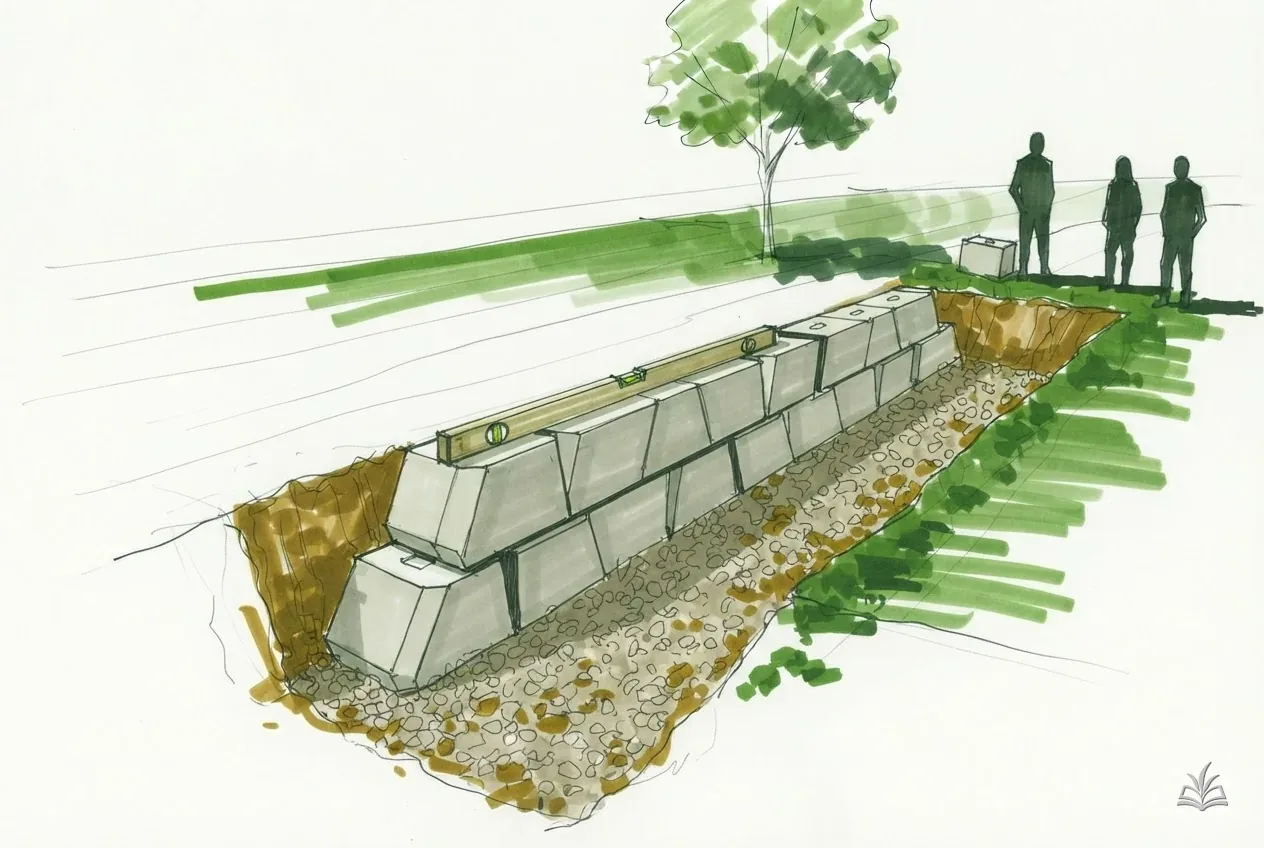
Add 4-6 inches of compactable gravel base (often called "road base" or "3/4-minus crusher run") to the trench. Compact in 2-inch lifts with a plate compactor or hand tamper. Check level every 4 feet along the trench. The base must be dead level — every error here multiplies as you build higher.
Set the First Course
Place the first row of blocks on the compacted base, pressing each block firmly into the gravel. Check level front-to-back and side-to-side after every block. For interlocking concrete blocks, knock off the rear lip on the first course so they sit flat. This course is the most important — take your time.
Pro tip: Use a rubber mallet to make fine adjustments. Never hammer on the face of the block, which can chip the visible surface.
Install Drainage Behind the Wall
Lay landscape fabric against the back of the wall and up the soil face behind it. Place a 4-inch perforated drain pipe (holes facing down) on the gravel base behind the first course. The pipe should slope at least 1 inch per 8 feet toward a daylight outlet or dry well. Cover with 12 inches of clean drainage gravel.
Stack Remaining Courses
Offset each course by half a block (running bond pattern) for structural strength. For interlocking blocks, the built-in lip handles the setback automatically. Backfill with drainage gravel behind each course as you go, compacting every 6-8 inches. For timber walls, drill through and drive 12-inch galvanized spikes or rebar every 4 feet.
Cap the Wall & Finish
Apply construction adhesive to the top course and set cap blocks. Cap blocks are wider than wall blocks, creating a finished ledge that sheds water. Fold the landscape fabric over the top of the gravel backfill and cover with 6 inches of topsoil. Grade the soil behind the wall away from the wall at a 2% slope.
Cross-section: proper drainage setup behind a retaining wall
Lifting safety: Standard concrete blocks weigh 50-80 lbs each. Lift with your legs, not your back. For walls over 50 linear feet, have materials delivered on a pallet and use a hand truck. Work with a partner whenever possible.
Cost Estimates by Material & Size
These prices assume a 3-foot tall wall. Costs scale roughly linearly with height — a 4-foot wall costs about 33% more than a 3-foot wall in the same material. Use our retaining wall calculator for a precise estimate for your exact dimensions.
Timber (DIY)
$8-$15
per sq ft face
Block (DIY)
$10-$18
per sq ft face
Stone (DIY)
$25-$60
per sq ft face
Total Project Cost (3 ft tall wall)
Includes materials, base prep, drainage, and cap blocks. Pro prices include labor.
| Material | DIY Cost | Pro Install | ||||
|---|---|---|---|---|---|---|
| 15 ft | 25 ft | 50 ft | 15 ft | 25 ft | 50 ft | |
| Concrete Block | $450-$810 | $750-$1,350 | $1,500-$2,700 | $1,200-$2,250 | $2,000-$3,750 | $4,000-$7,500 |
| Natural Stone | $1,125-$2,700 | $1,875-$4,500 | $3,750-$9,000 | $2,400-$5,400 | $4,000-$9,000 | $8,000-$18,000 |
| Timber | $360-$675 | $600-$1,125 | $1,200-$2,250 | $900-$1,650 | $1,500-$2,750 | $3,000-$5,500 |
Hidden Costs Most Guides Skip
The block price is only half the story. These extras add 30-50% to your materials budget. Factor them into your landscaping cost estimate.
Gravel base & drainage stone
$1.50-$3.00/sq ft of wall face
Perforated drain pipe + fittings
$0.75-$1.50/linear ft
Landscape fabric (filter fabric)
$0.15-$0.30/sq ft
Cap blocks / capstones
$3-$8/linear ft
Construction adhesive
$5-$8/tube (1 tube per 8-10 ft)
Plate compactor rental
$60-$90/day
Geogrid (walls over 3 ft)
$0.50-$1.00/sq ft
Delivery fee (blocks are heavy)
$75-$200 per load
Get an exact materials list. Run the retaining wall calculator with your wall dimensions.
DIY vs. Hire a Pro: Decision Guide
A retaining wall is one of the most rewarding DIY landscape projects — but also one of the most consequential if done wrong. A failed wall isn't just ugly; it's a liability. Here's an honest assessment of when to tackle it yourself and when to call a landscaping professional.
DIY It
- Wall is under 3 feet tall
- Straight wall on level ground (no curves on a slope)
- Using interlocking concrete blocks (most forgiving)
- Well-drained soil (sandy or loamy, not heavy clay)
- No utility lines in the trench area (confirmed via 811)
- You have a helper for lifting and placing blocks
- Budget is tight and you can invest 1-3 weekend days
Hire a Pro
- Wall is over 4 feet tall (engineering + permit required)
- Wall holds back a slope above a structure (patio, driveway, house)
- Heavy clay soil or high water table requiring special drainage
- Curved or terraced wall on steep terrain
- Natural stone (requires masonry skill to fit irregular pieces)
- Wall is on or near a property line (survey + setback compliance)
- You need the project done in 1-2 days, not 1-2 weekends
“The base is the wall. If you get the first course right, the rest is just stacking. If you rush the base, nothing you do above it will save the wall.”
5 Mistakes That Kill Retaining Walls
Skipping the gravel base
Wall shifts and leans within 1-2 years as soil settles unevenly beneath it
Fix: Always excavate to firm subgrade and add 4-6" of compacted gravel base
No drainage behind the wall
Hydrostatic pressure builds and pushes the wall outward, especially after heavy rain or spring thaw
Fix: Install perforated pipe + 12" of drainage gravel behind every wall over 2 feet
First course not level
Every subsequent course amplifies the error — a 1/4" deviation becomes 1" by the 4th course
Fix: Spend 50% of your time on the first course. Check level after every single block
Backfilling with native soil
Clay soil holds water against the wall, creating freeze-thaw pressure that cracks blocks
Fix: Use clean drainage gravel (3/4" clear stone) for the first 12" behind the wall
No cap or adhesive on top course
Top blocks shift, water infiltrates between courses, wall destabilizes from the top down
Fix: Glue cap blocks with polyurethane construction adhesive rated for masonry
Quick Reference: Retaining Wall Cheat Sheet
Trench depth: 6-8" (add 1" per ft of height)
Gravel base: 4-6" compacted crusher run
Drain pipe: 4" perforated, 1" slope per 8 ft
Backfill: 12" drainage gravel, then native soil
Block offset: Half-block running bond pattern
Max DIY height: 4 ft (check local code)
Cap adhesive: Polyurethane masonry adhesive
Grade behind wall: 2% slope away from wall
Bottom line: A concrete block retaining wall under 3 feet tall is a great DIY project that saves you 40-60% over hiring a contractor. Above 4 feet, the engineering and liability risks make professional installation the smarter choice. Either way, start with our retaining wall calculator to nail down your materials list and budget before breaking ground.