How to Install Pavers: Complete Step-by-Step Guide
March 8, 2026 · Updated October 18, 2026 · 14 min read
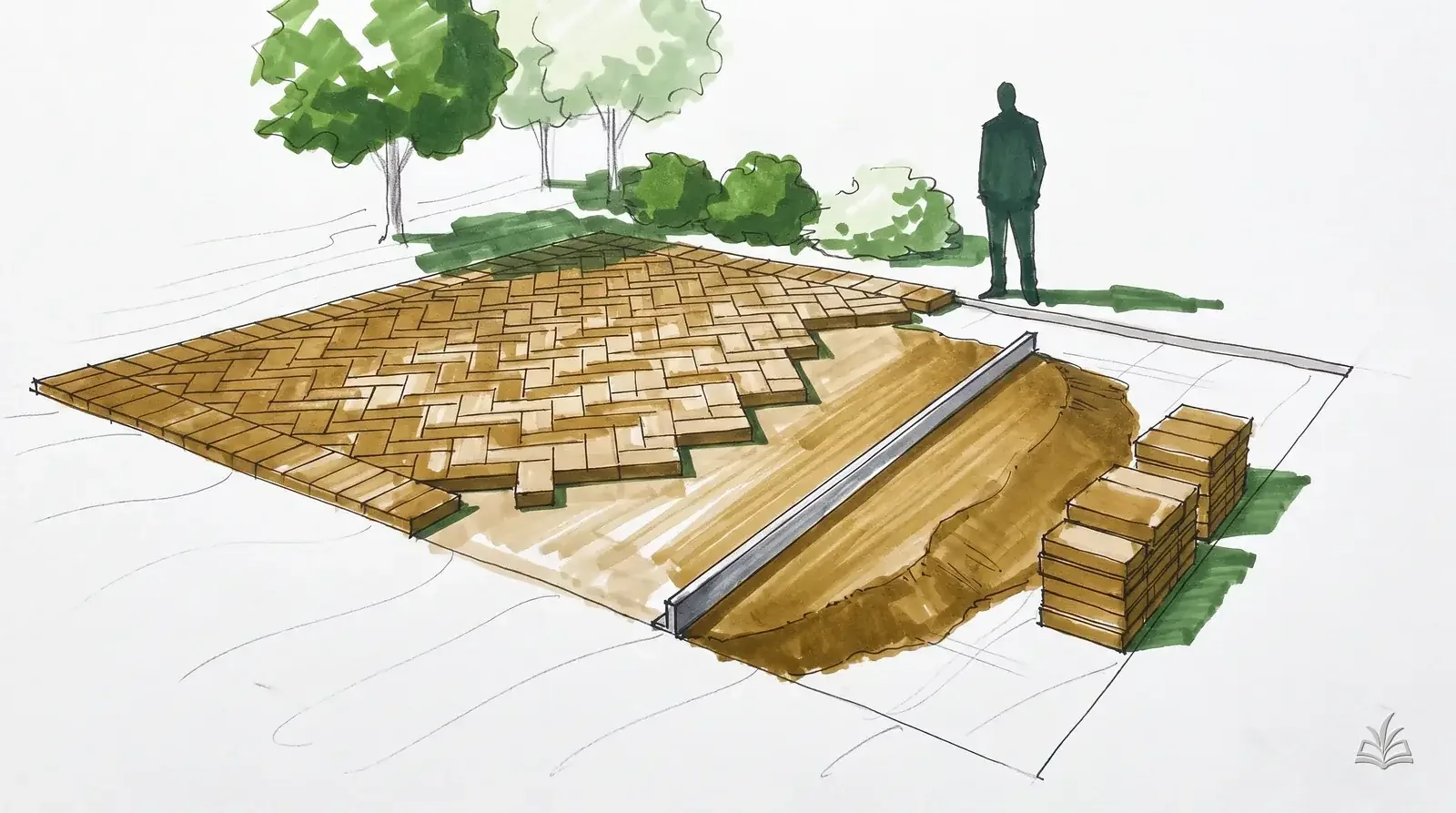
DIY Cost
$5-$12
per sq ft
Time
2-3
days (200 sq ft)
Base Depth
6-8"
patio / walkway
Paver patios and walkways rank among the most rewarding hardscape projects you can tackle yourself. The process is straightforward but unforgiving: most paver failures trace back to a poorly prepped base. This guide covers every step from layout to polymeric sand, with specific depths, material quantities, and the mistakes that cause settling. Use our paver calculator to estimate materials, and our gravel calculator for base stone quantities before you start.
Tools & Materials Checklist
Gather everything before you start — a mid-project supply run costs you half a day. Most homeowners already own the hand tools; the plate compactor and wet saw are the two rental items. Budget $120–$180 for a weekend rental of both.
| Category | What You Need |
|---|---|
| Layout & Measuring | String line, stakes, measuring tape, marking paint, framing square |
| Excavation | Flat shovel, round-point shovel, wheelbarrow, garden rake |
| Compaction & Leveling | Plate compactor (rent $60-$90/day), 4-ft level, screed bars (1" pipe) |
| Cutting | Wet saw or angle grinder with diamond blade, masonry chisel, safety glasses |
| Finishing | Rubber mallet, push broom, garden hose with shower nozzle |
| Safety | Safety glasses, hearing protection, work gloves, knee pads, dust mask |
Materials Shopping List
Run your dimensions through our paver calculator for exact quantities. The table below gives ballpark ratios.
| Material | Quantity | Notes |
|---|---|---|
| Pavers | Use paver calculator | Order 10% extra for cuts and future repairs |
| Crusher run gravel (3/4") | 0.5 cu yd per 27 sq ft | 4-6" compacted base layer |
| Bedding sand (concrete sand) | 0.1 cu yd per 27 sq ft | 1" screeded layer |
| Polymeric sand | 1 bag per 40-80 sq ft | Coverage depends on joint width |
| Edge restraint | Total perimeter in linear ft | Aluminum or plastic paver edging + 10" spikes |
| Landscape fabric | Same as paver area | Prevents soil migration into base (optional) |
Call 811 a few business days before digging (your state sets the exact notice period). Utility line strikes risk serious injury, repair bills and state penalties. The call is free and required by law.
Excavation & Base Prep
This is where your project succeeds or fails. A properly compacted base will hold pavers level for 25+ years. A rushed base fails within 2–3 seasons. The process is identical to retaining wall base prep, but the depth requirements differ.
Walkway
7"
4" gravel + 1" sand + 2" paver
Patio
8-9"
4-6" gravel + 1" sand + 2.5" paver
Driveway
12-14"
8-12" gravel + 1" sand + 3" paver
Lay Out the Area
Drive stakes at each corner and stretch string lines between them. Check for square by measuring diagonals — if both diagonals are equal, your layout is square. For curved paths, lay a garden hose to define the shape and mark with spray paint. Add 6 inches beyond your finished paver edge on all sides for edge restraint and working room.
Excavate to Depth
Remove sod, topsoil, and organic material down to firm mineral soil. Dig 7-9 inches deep for a walkway or patio (4" gravel + 1" sand + 2-3" paver thickness). For driveways, dig 10-14 inches (8-12" gravel + 1" sand + paver). Slope the excavation away from your house foundation at 1/4 inch per foot for drainage.
Pro tip: Use a depth gauge: cut a scrap 2x4 to your target depth and check frequently. Digging too shallow in one area means that paver will settle later.
Compact the Subgrade
Run a plate compactor over the entire excavated surface. This step is skipped by most DIYers — and it's the #1 cause of settling. The subgrade (native soil) must be firm and unyielding before you add any gravel. If the soil is soft clay, consider adding 2 inches of crusher run and compacting that into the subgrade.
Add Gravel Base in Lifts
Spread 3/4-inch crusher run (also called "road base" or "3/4-minus") in 2-inch lifts. Compact each lift with a plate compactor, making at least 3 passes in each direction. Never dump the full 4-6 inches at once — compaction only works to about 2-3 inches of depth. The finished base should be dead flat and rock-hard.
Screed the Bedding Sand
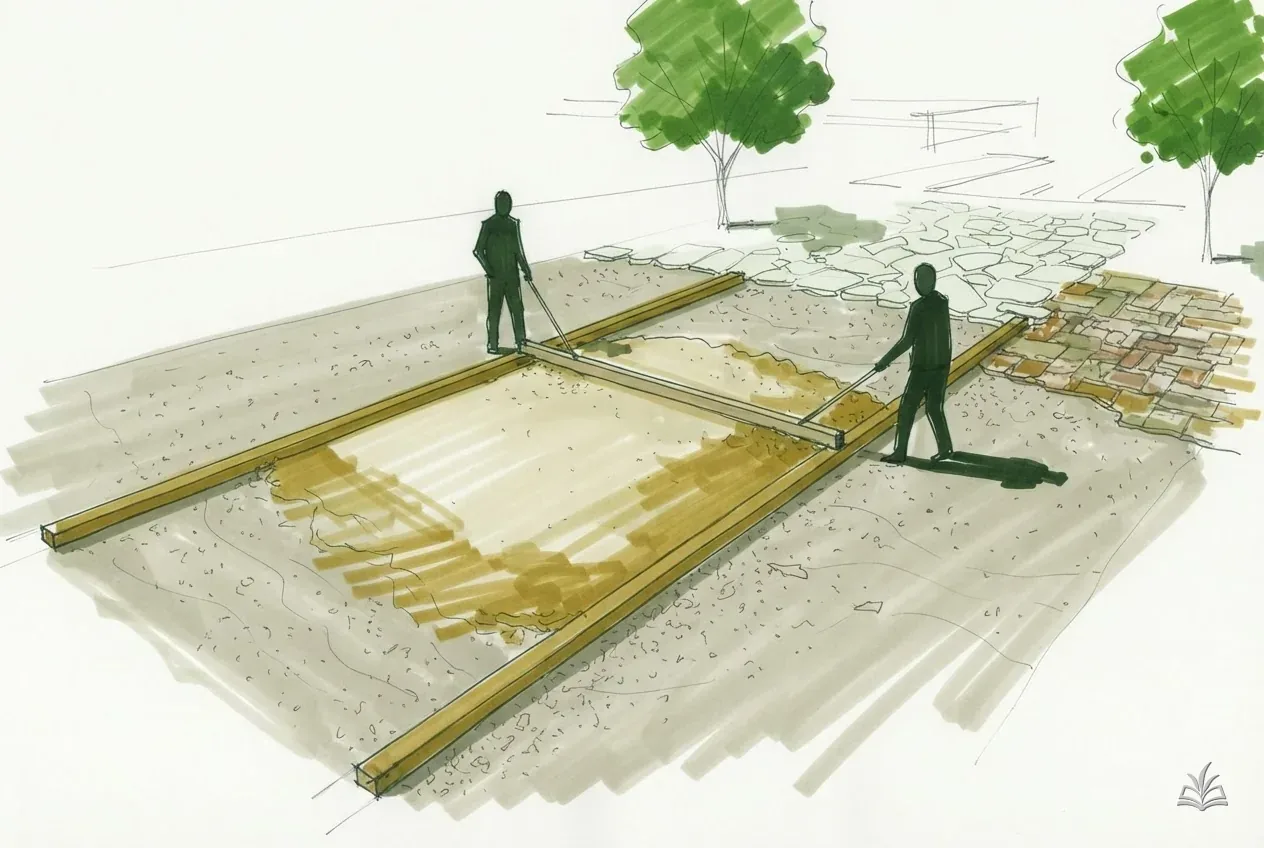
Set two 1-inch diameter pipes (or conduit) parallel on the compacted base, spaced about 4 feet apart. Pour concrete sand (NOT play sand, NOT polymeric sand) between the pipes and drag a straight 2x4 across the pipes to create a perfectly flat 1-inch sand bed. Remove the pipes and carefully fill the channels with sand. Do NOT compact the bedding sand — pavers need to settle into it.
Cross-section: proper paver base layers (patio/walkway)
Never use limestone screenings or stone dust as a base. These fine materials trap water, turning into a slurry that shifts pavers. Use only angular crusher run gravel that locks together when compacted.
Laying Patterns Compared
Your pattern determines both the look and the structural strength of your finished surface. Choose based on what the pavers need to withstand, not just aesthetics.
| Pattern | Strength | Difficulty | Waste | Best For |
|---|---|---|---|---|
| Herringbone (45° or 90°) | Highest | Advanced | 10-15% | Driveways, high-traffic patios |
| Running Bond | High | Beginner | 5-8% | Walkways, patios, pool decks |
| Basket Weave | Moderate | Moderate | 5-8% | Patios, garden paths, decorative areas |
| Stack Bond | Low | Beginner | 3-5% | Modern patios, stepping stones, light-duty areas |
Herringbone (45° or 90°)
Pavers interlock at 45° or 90° angles in a V-shaped zigzag. The discontinuous joint lines distribute load across a wider area than any other pattern, making it the strongest option for vehicular traffic.
Pros
- Strongest interlock — resists shifting under vehicle loads
- Excellent slip resistance due to angled joints
- Visually dynamic and timeless
Cons
- Most cuts required (especially at edges)
- Harder to keep aligned without string guides
- Higher material waste from angled edge cuts
Running Bond
Bricks laid end to end with each row offset by half a paver — the same pattern you see in traditional brick walls. Simple to execute and structurally sound for pedestrian use.
Pros
- Easiest pattern for first-time installers
- Minimal cutting required (only at edges)
- Easy to lift and replace individual pavers later
Cons
- Continuous joint lines in one direction reduce interlock
- Not recommended for driveways without additional stabilization
- Can look basic on large areas without border accents
Basket Weave
Pairs of pavers alternate between horizontal and vertical orientation, creating a woven appearance. Works best with rectangular pavers at a 2:1 length-to-width ratio.
Pros
- Eye-catching woven texture adds visual interest
- Moderate difficulty — predictable repeating module
- Few edge cuts needed with proper layout
Cons
- Weaker interlock than herringbone or running bond
- Not suitable for driveways or heavy loads
- Requires pavers with exact 2:1 ratio for clean look
Stack Bond
Pavers lined up in a perfect grid with continuous joints in both directions. Minimalist and modern but structurally the weakest pattern — joints align, so pavers can shift under load.
Pros
- Clean, modern aesthetic with strong geometric lines
- Lowest waste — almost no cutting needed
- Fastest pattern to lay
Cons
- Weakest interlock of all patterns
- Aligned joints create channels for water and weed growth
- Not suitable for any vehicular traffic
Our recommendation: Use herringbone for driveways and high-traffic areas. Use running bond for walkways and patios — it's the best balance of strength, simplicity, and material efficiency for most residential projects.
Laying Pavers & Cutting
With your base prepped and sand screeded, the actual paver laying is the most satisfying part. Work methodically, and you can lay 200–300 square feet in a day.
Laying Process
Start from a fixed edge
Begin laying pavers from a corner where two straight edges meet (house foundation, sidewalk, or straight edge restraint). Work outward so you push the sand bed away from your completed work, not into it. Never stand on the screeded sand — always kneel or stand on pavers you have already placed.
Place pavers straight down
Drop each paver straight onto the sand bed from about 1 inch above the surface. Do NOT slide pavers into position — sliding disturbs the screeded sand and creates high spots. Leave 1/8" to 3/16" gaps between pavers for joint sand.
Check alignment every 4-5 rows
Stretch a string line across your work and check that rows are straight. Small errors compound quickly — a 1/16" drift per paver becomes a 1" gap over 16 pavers. Tap pavers into alignment with a rubber mallet before proceeding.
Pull from multiple pallets
Paver color varies between manufacturing batches. Pull from 3-4 pallets simultaneously and mix pavers randomly to blend any color variation across the entire surface. This prevents noticeable color patches.
Install edge restraint
Before cutting border pavers, install aluminum or plastic edge restraint along all exposed edges. Secure with 10" landscape spikes every 12 inches. Edge restraint prevents lateral spreading — without it, pavers creep outward over time and joints open up.
Cutting Pavers
Every paver project requires cuts at edges, around obstacles, and at pattern transitions. There are two methods:
Wet Saw (Preferred)
- Clean, precise cuts every time
- Diamond blade handles any paver type
- Rental cost: $50-$80/day
- Water suppresses dust (important for silica safety)
- Can cut curves and notches with practice
Chisel & Hammer (Budget)
- Score a line with masonry chisel, then snap
- Works for straight cuts on concrete pavers
- No rental cost — tools you already own
- Rough edges hidden by joint sand
- Not suitable for natural stone or angled cuts
Save cuts for last. Lay all full pavers first, then come back and cut every border piece in a single session. This is faster than cutting as you go and ensures consistent cuts. Mark each paver in place, carry it to the saw, cut, and return it.
Silica dust warning: Cutting concrete pavers generates crystalline silica dust, which causes permanent lung damage. Always use a wet saw or wet the paver before cutting, and wear an N95 or P100 respirator, safety glasses, and hearing protection.
Once all pavers and cuts are placed, make one final pass with the plate compactor over the entire surface. Use a protective rubber pad on the compactor plate to prevent scuffing the paver faces. This seats the pavers firmly into the bedding sand and levels any slight height differences. Now you are ready for polymeric sand.
Polymeric Sand & Finishing
Polymeric sand is what locks everything together. When activated with water, the polymers bind the sand into a firm joint that resists weeds, ants, and washout. Mess this step up and you will have white haze on your pavers or crumbling joints within a season.
Check the forecast first. You need a dry surface before application and at minimum 24 hours of dry weather after activation. Rain within this window washes the polymers out before they cure, ruining the joint and wasting a $25–$45 bag of sand.
Confirm dry surface
Pavers and joints must be completely dry. No dew, no residual moisture from cutting. Check the weather — you need at least 24 hours with no rain after application.
Pour sand onto pavers
Dump polymeric sand directly onto the paver surface. Use a push broom to sweep sand into all joints, working in diagonal strokes so the broom doesn't pull sand back out of the joints.
Vibrate sand into joints
Run the plate compactor over the surface one pass to settle the sand deep into the joints. Re-sweep and compact again. Repeat until joints are filled to within 1/8" of the paver surface.
Blow off excess
Use a leaf blower on low setting to remove ALL excess sand from paver faces. Any polymeric sand left on the surface will haze white when activated and is extremely difficult to remove.
Activate with water
Set your hose to a gentle shower setting. Spray from about 4 feet above the surface — never blast directly into joints. Water in 3-4 minute intervals across small sections (50-80 sq ft at a time). The joints should darken and glisten but not puddle.
Allow to cure
Keep foot traffic off for 24 hours and vehicle traffic off for 48-72 hours. Full cure takes about a week depending on humidity and temperature.
Polymeric Sand vs Regular Sand
| Feature | Polymeric Sand | Regular Sand |
|---|---|---|
| Weed prevention | Excellent | None |
| Ant resistance | Excellent | None |
| Rain washout | Resists washout | Washes out easily |
| Cost per bag | $25-$45 | $5-$8 |
| Coverage | 40-80 sq ft/bag | 60-100 sq ft/bag |
| Reapplication | Every 3-5 years | Every 1-2 years |
| Installation difficulty | Moderate (timing critical) | Easy |
Three polymeric sand mistakes to avoid:
- 1. Not cleaning paver faces — leftover sand bonds to the surface and leaves permanent white haze
- 2. Over-watering — flooding the joints pushes polymers to the surface where they cure as a film, not in the joint
- 3. Underfilling joints — sand should be within 1/8" of the surface. Deep joints allow weeds and lose structural support
After the polymeric sand cures, your paver surface is complete. For ongoing maintenance, sweep debris regularly, re-apply polymeric sand every 3–5 years as joints erode, and consider sealing high-use areas for extra color protection. If you are planning adjacent landscape beds, see our flower bed edging guide for edging materials that pair well with pavers.
Cost Breakdown: DIY vs Hiring a Pro
DIY paver installation saves 40–60% compared to hiring a contractor. The materials are identical — the savings come entirely from labor. Here is what a typical 200 sq ft patio costs in 2026, broken down line by line.
DIY Total (200 sq ft)
$1,000–$2,400
$5–$12 per sq ft
Professional (200 sq ft)
$2,400–$5,000
$12–$25 per sq ft
| Item | DIY Cost | Pro Cost | Notes |
|---|---|---|---|
| Concrete pavers | $2-$6/sq ft | $2-$6/sq ft | Natural stone: $7-$16/sq ft |
| Crusher run gravel | $0.50-$1.00/sq ft | Included | Delivered by the ton |
| Bedding sand | $0.15-$0.30/sq ft | Included | Concrete sand only |
| Polymeric sand | $0.30-$0.60/sq ft | Included | 1 bag per 40-80 sq ft |
| Edge restraint | $0.50-$1.00/lin ft | Included | Aluminum or plastic |
| Tool rental | $120-$180/weekend | N/A | Compactor + wet saw |
| Labor | Your time | $8-$15/sq ft | Biggest cost difference |
When to Hire a Pro Instead
DIY makes sense for straightforward patios and walkways under 400 sq ft. Hire a professional when:
Use our landscaping cost calculator to estimate your total project budget including grading, pavers, and surrounding landscape work. If you are running a lawn care business and want to offer paver installation, check our pricing guide for help setting competitive rates.
Quick Reference Cheat Sheet
Bookmark this. The entire process in one view.
Paver Installation — 10-Step Summary
Mark Layout
Stakes + string. Check diagonals for square. Add 6" beyond finished edge.
Excavate
7-9" for patio, 12-14" for driveway. Slope 1/4" per foot from house.
Compact Subgrade
Plate compactor on native soil. Firm, unyielding surface.
Gravel Base
4-6" crusher run in 2" lifts. Compact each lift. 3 passes minimum.
Screed Bedding Sand
1" concrete sand. Use pipe rails + straight edge. Do NOT compact.
Lay Pavers
Start at fixed edge. Drop, don't slide. Pull from multiple pallets.
Install Edge Restraint
Aluminum/plastic edging. 10" spikes every 12". All exposed edges.
Cut Border Pavers
Wet saw preferred. Wear N95 + glasses. Do all cuts in one session.
Compact Pavers
Plate compactor with rubber pad. Seats pavers into sand bed.
Apply Polymeric Sand
Dry surface only. Sweep, compact, blow off excess, shower to activate.
DIY Cost
$5–$12
per sq ft
DIY Time (200 sq ft)
2–3 days
with plate compactor
Lifespan
25+ yrs
with proper base
Quick Material Formulas
Gravel base: Area (sq ft) × 0.33 ft depth ÷ 27 = cubic yards
Bedding sand: Area (sq ft) × 0.083 ft ÷ 27 = cubic yards
Pavers (4×8): Area (sq ft) × 4.5 = pavers needed (+10% for cuts)
Skip the math entirely — our paver calculator computes exact quantities for any dimensions. For gravel tonnage, use our gravel calculator. Planning a bigger hardscape project? See our guide on building retaining walls or browse drainage solutions for sites with water issues.