Best Planting Windows by Region
6 steps · 12 min read · Covers cool-season & warm-season grasses
Northeast
Cool-season: Aug 15 - Sep 15
Southeast
Cool-season: Sep 1 - Oct 15
Warm-season: May - Jun
Midwest
Cool-season: Aug 15 - Sep 15
West
Cool-season: Sep 1 - Oct 1
Warm-season: May - Jul
A thick, healthy lawn starts with proper seeding — and most homeowners get it wrong on the first try because they skip soil prep or water incorrectly. This guide walks you through every step from testing your soil to your first mow, with specific seed recommendations by climate zone and a watering schedule that actually works. Whether you are starting from bare dirt or overseeding a thin lawn, the process is the same.
Step 1
Test and Prep Your Soil
Healthy grass starts below the surface. Before you spread a single seed, test your soil pH and nutrient levels. Most lawn grasses thrive in a pH range of 6.0 – 7.0. If your soil falls outside that range, your seed will germinate poorly no matter how perfectly you do everything else.
Soil Prep Checklist
- 01Test soil pH — mail-in lab test ($10-$25) or DIY meter
- 02Apply lime if pH is below 6.0, or sulfur if above 7.5
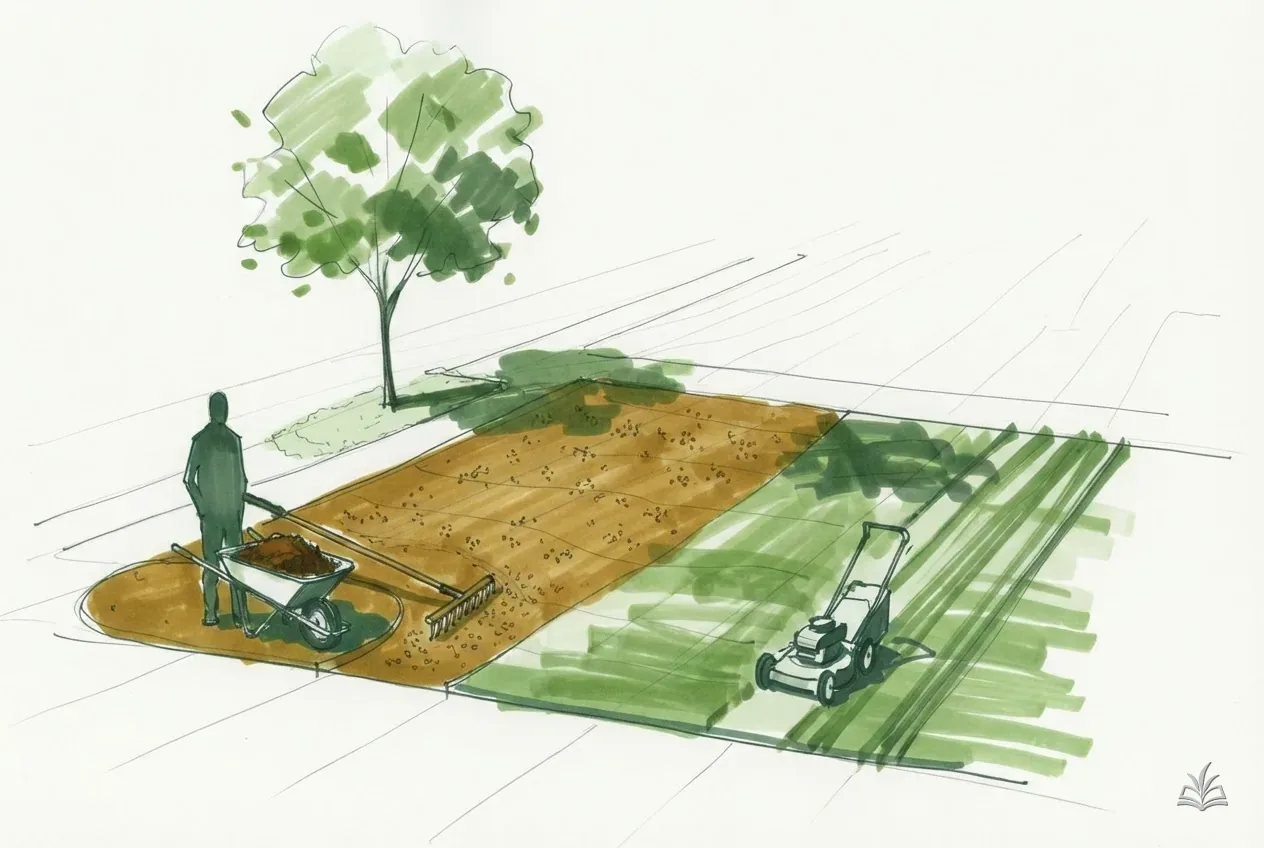
- 03Remove debris, rocks, and dead grass from the area
- 04Loosen the top 3-5 inches of soil with a tiller or garden fork
- 05Rake smooth — break up clods into fine particles
For overseeding an existing lawn, you can skip the tilling step. Instead, aerate the lawn first so seed falls into the holes and makes direct soil contact. Core aeration also breaks up compacted soil and improves drainage.
Step 2
Choose the Right Seed
The single biggest factor in seed selection is your climate zone. Cool-season grasses (bluegrass, fescue, ryegrass) grow best when soil temperatures are 50-65°F. Warm-season grasses (Bermuda, Zoysia, St. Augustine) need soil at 65-70°F+ to germinate. Planting the wrong type for your region is the most common (and most expensive) mistake homeowners make.
| Grass | Season | Sun | Germination | Best For |
|---|---|---|---|---|
| Kentucky Bluegrass | Cool | Full sun | 14-30 days | Northeast, Midwest |
| Perennial Ryegrass | Cool | Full sun | 5-10 days | Quick fill, overseeding |
| Tall Fescue | Cool | Sun to part shade | 10-14 days | Transition zone, drought |
| Fine Fescue | Cool | Shade tolerant | 10-14 days | Shady areas, low traffic |
| Bermudagrass | Warm | Full sun | 10-30 days | Southeast, Southwest |
| Zoysia | Warm | Sun to light shade | 14-21 days | Transition zone, foot traffic |
Not sure how much seed you need? Use our grass seed calculator to get the exact amount based on your lawn size and seed type.
Step 3
Best Grass Seed for Shade
Shady yards are the most common pain point for homeowners trying to grow grass. The key is matching the variety to how much light the area actually receives. Measure it honestly — 4 hours of direct sun is the minimum for most grass, and 3 hours is the absolute floor (fine fescue only).
Fine Fescue (Creeping Red)
3-4 hrs sunBest overall shade tolerance in cool climates. Needle-like blades, low maintenance.
Fine Fescue (Hard Fescue)
3-4 hrs sunExtremely low-maintenance. Thrives in poor soil. Rarely needs mowing.
Tall Fescue
4-5 hrs sunDeeper roots than fine fescue. Better foot-traffic tolerance.
St. Augustine (Palmetto)
4-6 hrs sunBest shade tolerance among warm-season grasses. Dense, carpet-like turf.
St. Augustine (CitraBlue)
4-6 hrs sunBlue-green color, semi-dwarf. Newer variety with improved shade performance.
Zoysia (Cavalier)
4-5 hrs sunFine-textured warm-season option. Moderate shade tolerance, slow growing.
Pro tip: If your area gets less than 3 hours of direct sun, no grass variety will thrive long-term. Consider shade ground covers like clover, mondo grass, or mulched beds instead.
Step 4
Spreading Technique
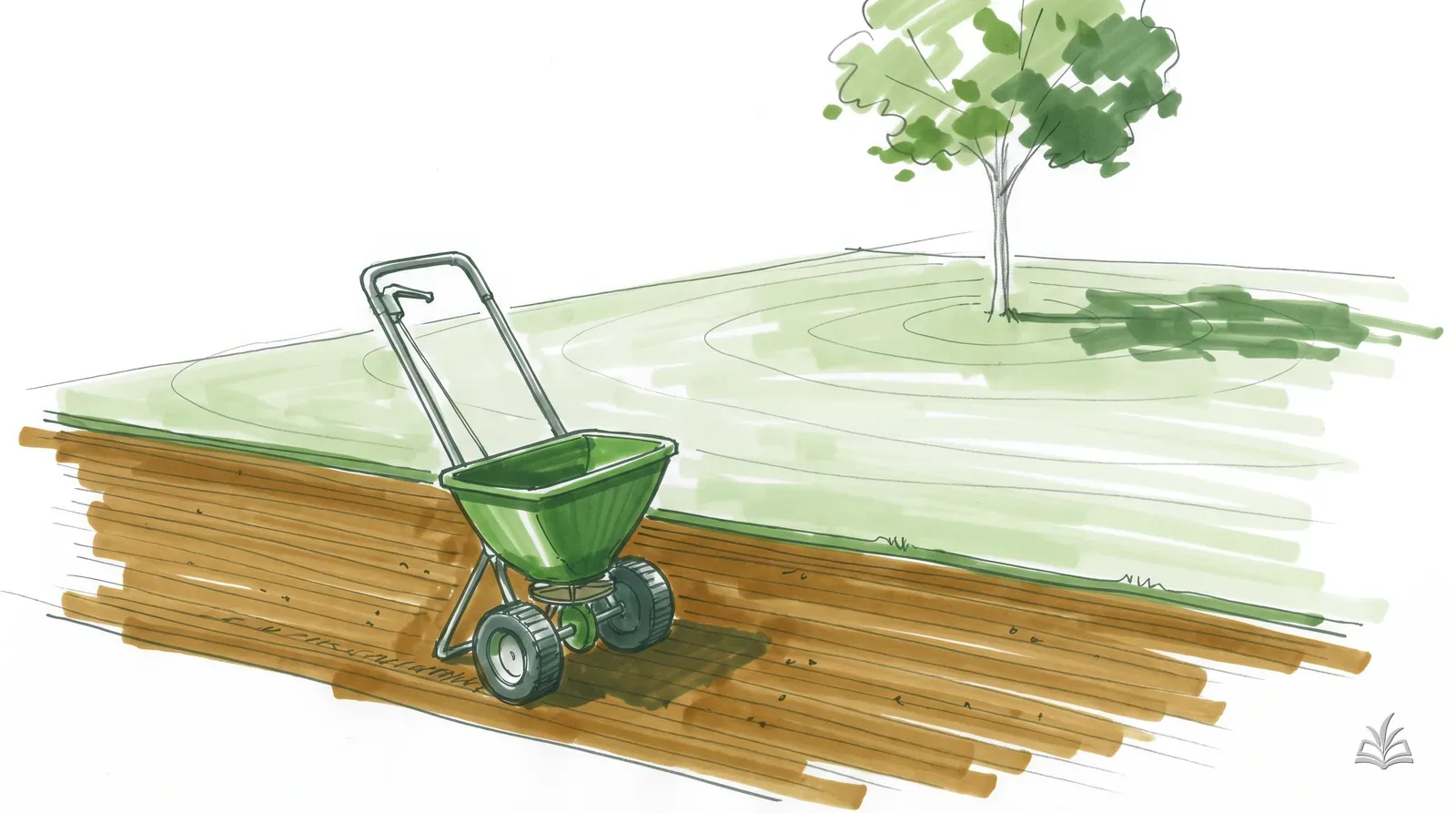
Even seed distribution is critical. Bare patches and clumping are almost always caused by bad spreading technique, not bad seed. You have two main options:
Broadcast Spreader
Throws seed in a wide arc. Best for large lawns (1,000+ sq ft). Covers ground fast but can be less precise near edges.
Drop Spreader
Drops seed in a precise strip directly below. Best for small or irregularly shaped lawns where you need control near garden beds.
The Crisscross Method
Set your spreader to half rate, then make two passes at right angles — north-south, then east-west. This prevents stripes and ensures even coverage without double-dosing any area.
After spreading, lightly rake the seed into the soil — you want about ¼ inch of soil contact. Then apply a thin layer of straw mulch or peat moss to retain moisture and protect seed from birds.
Step 5
Watering Schedule
Watering is where most seeding projects fail. New seed needs consistent moisture to germinate, but overwatering causes fungus and washes seed away. Follow this phased schedule to get it right:
Days 1-7
Keep soil surface moist at all times. Never let it dry out.
Days 8-14
Seedlings emerging. Reduce frequency, increase duration slightly.
Weeks 3-4
Roots developing. Train grass to grow deeper by watering less often.
Week 5+
Transition to normal lawn watering. Deep, infrequent soaks.
Key rule: Water early morning (6-10 AM). Evening watering leaves grass wet overnight, which invites fungal disease. If you must water twice a day during germination, do morning and early afternoon.
Step 6
First Mow Timing
Resist the urge to mow too early. Cutting new grass before the roots are established can rip seedlings out of the ground entirely. Wait until your new grass reaches at least 3-4 inches tall, then mow to 2-2.5 inches.
Mow When Height Reaches
3-4″
Cut Down To
2-2.5″
Never remove more than 1/3
Typical Timeline
3-4 wk
After germination
Blade sharpness matters. A dull mower blade tears new grass instead of cutting it cleanly, which stresses seedlings and invites disease. Sharpen or replace your blade before the first mow. For ongoing mowing frequency, check our mowing frequency guide.
Best Planting Windows by Region
Timing your seeding to match your regional climate is the difference between thick turf and patchy failure. Here is the breakdown:
Northeast
Cool-seasonNY, NJ, PA, CT, MA, NH, VT, ME, RI
Best Window
Aug 15 - Sep 15
Soil Temp
55-65°F
Top Picks
Kentucky Bluegrass, Perennial Ryegrass, Fine Fescue
Fall seeding outperforms spring by 2:1 in establishment rates
Southeast
Warm-seasonFL, GA, SC, NC, AL, MS, LA, AR, TN
Best Window
Late Apr - Jun
Soil Temp
65-70°F+
Top Picks
Bermudagrass, St. Augustine, Zoysia
Wait until last frost risk passes; soil must be consistently warm
Midwest
Cool-seasonOH, MI, IN, IL, WI, MN, IA, MO, KS, NE
Best Window
Aug 15 - Sep 15
Soil Temp
55-65°F
Top Picks
Tall Fescue, Kentucky Bluegrass, Perennial Ryegrass
Spring seeding possible Apr-May, but fall has less weed competition
West & Southwest
VariesCA, AZ, NV, CO, UT, OR, WA
Best Window
Sep - Oct / May - Jun
Soil Temp
55-70°F
Top Picks
Tall Fescue (coastal), Bermuda (desert), Ryegrass (PNW)
Irrigation is critical; time planting with seasonal rain patterns
7 Common Mistakes to Avoid
Avoid These — They Kill New Lawns
Planting at the wrong time
Cool-season: fall. Warm-season: late spring. Never mid-summer or late fall.
Skipping soil prep
Seed needs soil contact to germinate. Throwing seed on compacted ground wastes money.
Watering too much or too little
Light, frequent watering for germination. Deep, infrequent after establishment.
Mowing too soon
Wait until grass is 3-4 inches. Early mowing pulls up fragile seedlings.
Using cheap seed with high weed content
Check the label: look for less than 0.5% weed seed and 85%+ germination rate.
Applying weed killer too early
Pre-emergent herbicides prevent grass seed from sprouting too. Wait until after the 4th mow.
Not using starter fertilizer
New seedlings need phosphorus for root development. Apply at seeding time.
Quick Reference Cheat Sheet
Bookmark this. Everything you need in one view.
How to Plant Grass Seed — 10-Step Summary
Test Soil pH
Target 6.0-7.0. Amend with lime or sulfur.
Prep the Ground
Loosen 3-5″, rake smooth, remove debris.
Pick Your Seed
Cool-season (fall) or warm-season (spring).
Spread at Half Rate
Two passes in crisscross pattern.
Rake & Mulch
¼″ soil contact, thin straw layer on top.
Water 2-3x Daily
Keep moist (not soggy) for 7-14 days.
Reduce Watering
Every other day weeks 3-4, then 2-3x/week.
First Mow at 3-4″
Sharp blade. Cut to 2-2.5″. ~3-4 weeks.
Apply Starter Fertilizer
At seeding. Phosphorus for root growth.
No Weed Killer Until 4th Mow
Pre-emergent blocks grass seed too.
Seeding Rate (new lawn)
4-8 lbs
per 1,000 sq ft
Germination Time
5-30 days
varies by grass type
Full Establishment
8-12 wk
before heavy use
Need help calculating seed amounts? Our grass seed calculator gives you exact quantities based on your lawn dimensions. For post-seeding nutrition, follow our lawn fertilizer schedule.