How Much Does Tree Trimming Cost in 2026?
August 24, 2026 · Updated October 18, 2026 · 14 min read
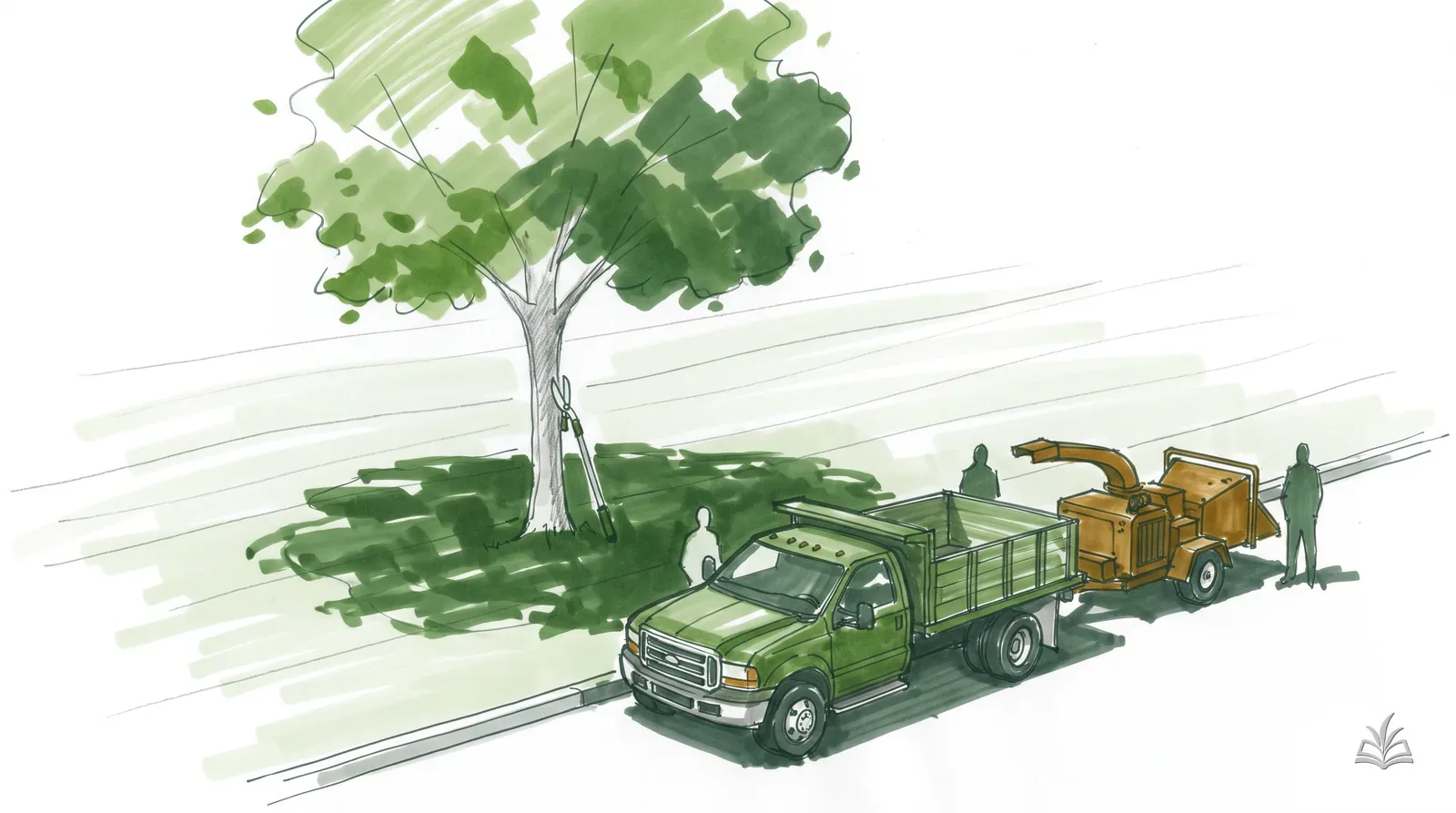
Estimated trim for a 40-ft tree, normal access:
$625 - $1,325
Mature oaks, pines, most shade trees. Full climb or bucket truck, rigging for heavier limbs, half a day for a crew.
Ranges blended from HomeAdvisor, Angi, HomeGuide, Fixr and LawnStarter 2026 cost guides. Add 25-50% for trees over power lines, tight backyards, or crane work.
Professional tree trimming costs about $460 per tree on average in 2026, with most jobs between $200 and $1,000. A small ornamental runs $75-$150; a 70-ft oak over a roof runs $1,500-$2,000. Stump grinding is priced separately at $2-$5 per inch of diameter. This guide breaks down the price by height, species, and access, explains when an ISA Certified Arborist is worth the rate, and shows landscapers how to sub out or price tree work themselves. For the broader service-pricing picture, see the lawn care pricing guide.
National Average Tree Trimming Cost
Every major cost guide lands in the same neighborhood: professional tree trimming costs about $460 per tree on average, with most jobs falling between $200 and $1,000. The floor is a $75-$150 minimum call-out for a small ornamental. The ceiling is $1,500-$2,000 for a mature oak over a house, and crane jobs go past that.
| Source | Range per tree | Notes |
|---|---|---|
| HomeAdvisor (2026) | $75 - $1,500 | National range; ~$460 average |
| Angi (2026) | $75 - $1,800 | $460 average; small trees closer to $150, medium ~$475 |
| HomeGuide (2026) | $150 - $1,500 | Per tree; height is the first split |
| Fixr (2026) | $100 - $1,500 | Palm range; oaks and hardwoods run higher |
| LawnStarter (2026) | $430 - $640 | Typical per-tree window; $78 small tree to $1,835 over 60 ft |
Why such a wide spread? Because “tree trimming” covers everything from a 20-minute pole-saw job on a crabapple to a full-day crown reduction with a bucket truck and chipper. Tree services price on crew hours, not per cut. A two-person climbing crew bills roughly $150-$250 per hour, a bucket truck crew $200-$350, and those hourly rates explain almost every number on this page. If you also need landscaping work quoted alongside the tree job, run the numbers in our landscaping cost calculator.
Tree Trimming Cost by Height
Height is the first thing a tree service looks at, because it decides the equipment. Under 30 feet a climber with a pole saw handles it. Past 30 feet you need a bucket truck or a rope-and-saddle climb with rigging to lower limbs. Past 60 feet, you are paying for a full crew, a chipper, and often a crane day rate of $500-$1,500 on top.
| Height | Cost per tree | Crew & gear | Time | Typical trees |
|---|---|---|---|---|
| Under 20 ft | $75 - $300 | 1-2 people, pole saw, ladder | 1 hr | Crabapple, dogwood, Japanese maple, young fruit trees |
| 20 - 30 ft | $150 - $450 | 2 people, short climb | 1-2 hrs | Redbud, mature fruit trees, crepe myrtle, small magnolia |
| 30 - 45 ft | $450 - $750 | 2-3 people, climb or bucket | 2-4 hrs | Red maple, Bradford pear, river birch, young oak |
| 45 - 60 ft | $600 - $1,000 | 3 people, bucket truck, rigging | 4-6 hrs | Mature maple, ash, elm, most pines |
| 60 - 80 ft | $1,000 - $1,500 | 3-4 people, bucket + rigging | Half to full day | Mature oak, sycamore, tulip poplar, tall pine |
| 80 ft and up | $1,500 - $2,500+ | 4+ people, crane possible | Full day | Old-growth oak, cottonwood, Douglas fir, redwood |
Multi-tree discount: once the truck and chipper are on site, each additional tree of the same size usually runs 20-40% less than the first. Three 35-ft maples might quote $1,400 total, not 3 x $600. Always ask for a per-tree breakdown on multi-tree jobs.
Tree Trimming Prices by Species
Species matters less than height, but it changes the work. Hardwoods like oak have heavy limbs that need rigging. Pines are tall but light. Palms are their own category and are usually priced per trunk foot.
Oak
$450 - $1,800
Dense, heavy wood; large canopies; most are 50-80 ft mature. Trim only in dormant season in oak-wilt regions (roughly Feb-Jun ban across TX, MN, WI).
Pine
$250 - $1,200
Tall but narrow; limbs are lighter. Pitch gums up saws and clothing. Dead-wooding lower limbs on a 50-ft pine is a fast job.
Maple
$200 - $1,000
Common shade tree, moderate wood weight. Avoid heavy pruning in spring when sap runs.
Palm
$100 - $650 (up to $1,500 over 80 ft)
No branches, just fronds and seed pods. Priced per palm by trunk height; spikes or bucket truck. Queen and date palms cost more than sabal or pygmy date.
Fruit trees
$75 - $400
Apple, pear, peach, citrus. Small, but annual structural pruning takes skill. Many services charge a flat $100-$150 per tree for orchard-style pruning.
Crepe myrtle
$75 - $250
Cheap and fast, but 'crepe murder' topping is the most common trimming mistake. Pay for thinning, not topping.
Sycamore / cottonwood
$800 - $2,000
Fast growers with brittle wood and 70-100 ft heights. Frequently over roofs and lines. Crane work is common.
Palm tree trimming is a different job
A palm does not get “pruned” in the arborist sense. The crew removes dead or drooping fronds below horizontal, seed pods, and old frond bases (the “boots”). HomeGuide puts palm trimming at $100-$650 on average, $150-$900 for 30-60 ft trunks, and $1,000-$1,500 for palms over 80 feet. Skinning a palm (removing all boots for the smooth look) adds $100-$300. In Florida, Arizona, and Southern California most services offer a per-palm flat rate and annual contracts at 15-25% off for the whole property.
Do not let anyone hurricane-cut a palm. Removing green fronds above horizontal starves the tree and weakens the trunk. It is cheaper by the visit and costs you the tree in a few years. Only dead, yellow, or hanging fronds should come off.
What Drives the Price Up (or Down)
Two 50-ft oaks can quote $600 and $1,400 on the same street. The difference is almost always access and what is underneath the canopy. Here is what estimators are actually looking at when they walk the property.
Bucket truck vs. climb
Climb costs more
If the truck can park under the canopy, the job goes fast. A tree in a fenced backyard means a rope-and-saddle climb: slower, more skilled labor, and usually 25-50% more.
Power lines
+30-60%, or utility handles it
Anything within 10 ft of primary lines needs a line-clearance qualified crew. Many companies refuse. Call the utility first; trimming around their lines is often free.
Over structures
+20-40%
Limbs over a roof, pool, or fence have to be roped down piece by piece instead of dropped. Every rigged limb is 3-5x the time of a free drop.
Debris haul-away
$50-$200, or included
Chipping and hauling is usually bundled. Ask. Leaving the chips on-site as mulch can knock $50-$100 off the quote.
Travel & minimum charge
$75-$150 minimum
Most services have a minimum visit fee. Rural properties 30+ minutes out get a trip charge or a higher minimum.
Emergency or storm work
1.5-3x normal
After-hours, weekend, or storm-damage calls bill at overtime rates. A hanging limb on a roof after a storm might run $500-$1,500 for what would be $300 on a Tuesday.
Tree health & deadwood
+10-30%
Dead limbs are unpredictable and brittle, so climbers move slower. Diseased trees may need tool sterilization between cuts.
Permits
$25-$150 where required
Many cities (Austin, Atlanta, Portland, much of California) require permits for trimming heritage or protected trees above a certain trunk diameter. The contractor usually pulls it and passes the cost through.
Wood chips are the one place you can turn a cost into a credit. A single 50-ft oak trim can produce 3-6 cubic yards of chips, which is a season of mulch for most beds. Use the mulch calculator to see how far a chip pile goes before you pay to haul it away. If trimming is part of fixing a soggy, shaded corner of the yard, read our landscape drainage solutions guide; opening the canopy is often step one.
How Much Does Stump Grinding Cost?
$2 - $5
per inch of diameter
Stump grinding costs $2-$5 per inch of stump diameter, measured at ground level across the widest point, with a $100-$150 minimum per visit. Most residential stumps run $150-$400 (Angi, HomeGuide, LawnLove 2026). High-cost metros see $4-$7 per inch.
Measure the stump the way the grinder will: ground-level width including the flare, not the trunk width above it. A tree that was 20 inches across at chest height is often 30+ inches at the base. That is where surprise quotes come from.
| Stump diameter | Math | Expect to pay | Notes |
|---|---|---|---|
| 12" | 12 x $4 | $100 - $150 | Hits the minimum charge |
| 18" | 18 x $4 | $100 - $150 | Still near minimum |
| 24" | 24 x $4 | $100 - $175 | Average backyard stump |
| 36" | 36 x $4 | $150 - $250 | Mature shade tree |
| 48" | 48 x $4 | $200 - $350 | Old oak; may need a tow-behind grinder |
Stump grinding add-ons
- Extra depth: standard grind is 4-6 inches below grade. Going 12+ inches for a new patio or planting adds $25-$75.
- Surface roots: chasing large roots out from the stump runs $50-$150 extra.
- Grindings removal: hauling the mulch pile away is $50-$100. Most people rake it into beds instead.
- Fill and seed: topsoil plus seed to close the hole is $30-$80 as an add-on.
- Multiple stumps: the second and later stumps on the same visit often drop to $1.50-$3 per inch.
- Full stump removal (digging out the root ball) is a different service: $300-$600+ per stump, and only worth it if you are building on that spot.
Bundle it with removal. When a tree comes down, stump grinding quoted the same day usually adds $100-$200. Called separately later, the minimum visit charge and a new mobilization make it $150-$350 for the same stump.
Tree Removal Cost vs. Trimming Cost
Removal averages around $750 per tree (Angi) with a $400-$1,200 typical range (HomeGuide), so it is only about 50-80% more than a heavy trim on the same tree. That surprises people. The reason is that a full removal is mostly the same work as a big crown reduction, plus dropping the trunk, and the trunk is the easy part.
Trim when
- The tree is healthy and you want it to stay
- Limbs are touching the roof, gutters, or lines
- Deadwood is under 25% of the canopy
- You want more light on the lawn or garden
- Storm-damaged limbs, trunk intact
Remove when
- More than 50% of the canopy is dead
- Trunk has cavities, fungus shelves, or a lean that changed
- Roots are lifting the foundation or driveway
- It is a short-lived species at end of life (Bradford pear, silver maple)
- You would be paying for a major trim every 2-3 years
| Tree height | Trimming | Removal (stump extra) |
|---|---|---|
| Under 30 ft | $75 - $450 | $200 - $500 |
| 30 - 60 ft | $450 - $1,000 | $500 - $1,500 |
| 60 - 80 ft | $1,000 - $1,500 | $800 - $2,000 |
| 80 ft and up | $1,500 - $2,500+ | $1,500 - $3,000+ |
Removal quotes rarely include the stump. Add the grinding cost above, or expect the tree service to bundle it for $100-$200 while they are on site.
When You Need an ISA Certified Arborist
What the credential means: the International Society of Arboriculture (ISA) issues the Certified Arborist credential to people with at least three years of full-time tree-care experience (or a related degree plus one to two years) who pass a 200-question exam covering pruning, tree biology, soil, diagnosis, safety, and risk assessment. It is voluntary, renewed every three years with continuing education, and holders sign a code of ethics.
Anyone can call themselves an arborist. Only ISA Certified Arborists are searchable in ISA's public directory (treesaregood.org). Rates run $100-$250 per hour, and a written tree risk assessment is typically $150-$450.
You do not need a certified arborist to dead-wood a maple. You do want one on the crew, or at least walking the job, when:
- The tree is old, large, or a protected/heritage species (permits often require an arborist report)
- You suspect disease: oak wilt, Dutch elm, emerald ash borer, root rot
- The tree leans toward a house and you need a stay-or-go decision
- You want a crown reduction, not a topping. Topping is what uncertified crews sell because it is fast
- Construction is happening inside the drip line
DIY tree trimming: where the line is
Tree work is consistently among the most dangerous jobs in the country; falls, struck-by limbs, and chainsaw injuries are the big three. The savings on a small tree are real. The savings on a big tree are not worth a ladder-and-chainsaw ER visit.
Reasonable to DIY
- Branches under 2 inches thick you can reach from the ground
- Fruit trees and ornamentals under 15 ft with hand pruners or a pole saw
- Suckers, water sprouts, and crossing limbs at eye level
- Deadwood on a ladder no higher than the second step, with a spotter
Hire it out
- Anything requiring a chainsaw above shoulder height
- Any limb within 10 ft of a power line (call the utility)
- Limbs over a roof, car, fence, or neighbor's property
- Trees over 20 ft that would need you on a ladder with a saw
- Storm-damaged limbs under tension (they spring when cut)
For Landscapers: Subcontracting Tree Work and What to Charge
Customers ask their lawn guy about the tree first. You can say “call a tree service,” or you can quote it, sub it out, and keep the relationship and a margin. Most landscapers who add tree work start by subbing everything over 20 feet and doing small ornamental pruning in-house.
Subcontractor markup
A 15-30% markup on the sub's price is standard for coordinating, being on site, and carrying the customer relationship. Go higher on small jobs (the coordination time is the same) and lower on big removals where the number gets noticed.
| Job | Sub's price | Your quote | Margin |
|---|---|---|---|
| Sub quotes 45-ft maple trim | $650 | $780 - $850 | 20-30% markup |
| Sub quotes 2 stumps, 24" + 30" | $250 | $325 - $350 | 30-40% markup |
| Sub quotes 70-ft oak removal | $1,600 | $1,850 - $2,000 | 15-25% markup |
- Get the sub's certificate of insurance every year and have them list you as additional insured. An uninsured sub's injury on your job lands on your policy at audit.
- Put the tree line item on your own estimate template so the customer signs one document and pays you, not the sub.
- Collect a deposit on anything over $1,000. Tree subs want to be paid the day they finish.
Adding tree services in-house: the insurance reality
The moment you own a chainsaw for hire above ground level, your insurance changes class. Insureon puts the average tree-service general liability policy at about $156 per month, versus about $57 for lawn care, and workers' comp for climbers is rated far higher than for mowing crews. Some carriers exclude tree work over a set height from a landscaping policy entirely; check your exclusions before the first job. Run your own numbers in the lawn care insurance cost calculator and read the lawn care business insurance guide for the coverage types.
How much to charge for tree trimming yourself
Price crew-hours, not trees. A two-person ground crew with a pole saw and a chipper rental should bill $150-$200 per hour with a 2-hour minimum ($300-$400). That covers a $40-$60/hr climber, a $20-$25/hr groundie, chipper rental ($150-$250/day), dump fees, insurance load, and a 20-30% net margin. Walk the job, count the cuts that need rigging, estimate hours, then check the total against the height table above. If you land far under the market range, you missed something. Our how to price lawn care jobs guide walks through the same hourly-rate build-up, and the lawn care pricing guide has the regional multipliers. Before the first crew day, run through the landscaping safety checklist; chainsaw and ladder items are on it for a reason.
How to Get an Accurate Tree Trimming Quote
Most bad tree-service experiences come from a vague scope, not a bad crew. Six things that keep the quote honest and the final bill equal to the quote:
- 1
Get three written quotes
Tree quotes vary 2x for the same job. Three bids tells you which one missed something (or padded something).
- 2
Ask for the certificate of insurance
General liability plus workers' comp, and call the agent on the certificate. A crew without comp puts the injury claim on your homeowner's policy.
- 3
Get the scope in writing
Which limbs, how much canopy (a 10-15% crown thin is normal; over 25% stresses the tree), whether debris and stump are included, and cleanup standard.
- 4
Confirm who calls the utility
Anything near lines: the contractor should say so and either coordinate the utility or refuse the job. Both are the right answer.
- 5
Ask about timing
Dormant-season pruning (late winter) is often 10-20% cheaper because crews are slow, and it is better for most hardwoods. Avoid spring for oaks and elms in disease areas.
- 6
Never pay in full up front
A deposit for crane or permit costs is fair. Full payment before the truck shows up is not.
“If the quote is half of everyone else's, it is not a deal. It is a crew without insurance, or a crew that is going to top your tree.”
Quick Reference: Tree Trimming Costs 2026
Every number on this page in one box.
Tree Trimming & Stump Grinding Cheat Sheet