Landscaping Safety Checklist
A checkable, printable crew safety checklist covering PPE, mowers and equipment, chemicals, heat, trailers, chainsaws, and jobsite hazards — built on OSHA general industry rules so your lawn care business has a documented safety routine from day one.
Quick answer
A landscaping safety checklist should cover eight areas: PPE, mowers, trimmers and blowers, chemicals, heat, vehicles and trailers, chainsaw work, and the jobsite itself. Landscaping crews are covered by OSHA's general industry standards (29 CFR 1910), including PPE (1910.132) and Hazard Communication (1910.1200), and BLS counted 102 landscaping and groundskeeping deaths in 2023 — a fatality rate nearly six times the all-worker rate of 3.3 per 100,000 in the 2024 census. Review the list below with your crew before work starts, add your own rules, and print the signed copy.
Check items off as your crew reviews them, add your own company rules, and print a clean sign-off sheet for the truck. Nothing is saved to a server — print or copy before you leave the page.
Landscaping Crew Safety Checklist
MowBook — mowbook.co · Review before work begins. Initial each item or check the box.
Crew readiness
0%
0 of 55 items reviewed
Personal Protective Equipment (PPE)
0/7Mowers & Powered Equipment
0/8String Trimmers & Blowers
0/6Chemicals & Pesticides
0/8Heat & Weather
0/6Vehicles & Trailers
0/7Chainsaw & Tree Work
0/7Jobsite & Public Safety
0/6Crew Sign-Off
Each crew member confirms the checklist was reviewed before work began. Keep signed copies on file — they matter for insurance claims and OSHA inspections.
Name
Signature
Date
Name
Signature
Date
Name
Signature
Date
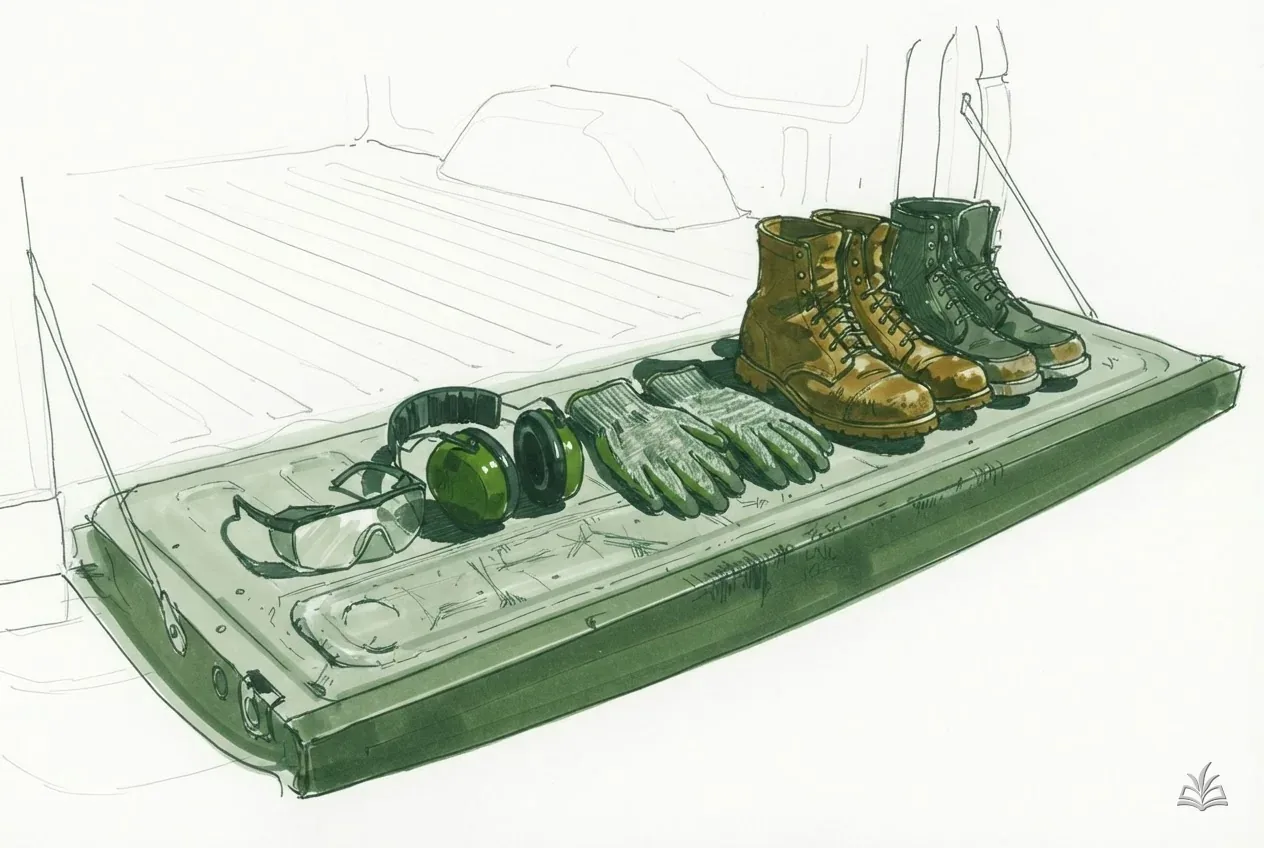
What Is a Landscaping Safety Checklist?
A landscaping safety checklist is a written pre-work review that a crew completes before running mowers, trimmers, chainsaws, or chemicals — confirming PPE, equipment guards, chemical handling, heat precautions, and jobsite hazards item by item. Done daily or weekly with a signed record, it is the simplest form of the written safety program OSHA expects employers to maintain, and the document insurers ask for first after a claim.
How to Use This Checklist
- 1
Review each category with the crew
Work through the eight sections at the trailer before the first job — PPE through jobsite. Check off each item as it's confirmed, not before.
- 2
Add your company's own rules
Every operation has house rules — a client's gate code policy, a two-person rule for the 60" mower. Add them with the field under each category.
- 3
Collect crew sign-offs
Type each crew member's name, then print. Signature and date lines print blank for wet-ink signatures.
- 4
Print and file it
Print gives you a clean one-page(ish) sheet with the sign-off block. Keep signed copies for at least a year — they are your paper trail for insurers and OSHA.
Why Landscaping Crews Need a Written Safety Checklist
Lawn care looks routine, but the numbers say otherwise. The Bureau of Labor Statistics counted 102 landscaping and groundskeeping worker deaths in 2023 — the most of any occupation in its sector — and NIOSH puts the fatality rate for grounds maintenance workers at roughly 19 per 100,000 full-time workers, nearly six times the all-industry rate of 3.3 in the 2024 census. Most incidents trace to the same handful of causes: mower rollovers on slopes, struck-by objects, tree work, transportation, and heat.
~19 per 100k
Fatality rate for grounds maintenance workers (FTE)
vs. 3.3 across all U.S. workers — nearly 6x the average (NIOSH; BLS CFOI 2024)
102
Landscaping & groundskeeping deaths in 2023
Trees, logs, and limbs were the leading source (BLS CFOI, 2023)
80°F
Heat index that triggers water, shade, and rest under OSHA's proposed rule
Proposed Aug 2024, not yet final; 90°F adds mandatory paid breaks
A daily checklist doesn't just prevent injuries — it protects the business. Documented safety reviews lower your insurance costs over time, strengthen your defense if a claim is filed, and are the first thing an OSHA inspector or workers' comp carrier asks to see after an incident.
OSHA Requirements for Lawn Care Businesses
There is no single "landscaping standard." OSHA covers landscape and horticultural services (NAICS 561730) under the general industry standards (29 CFR 1910), with construction standards (29 CFR 1926) applying when you build retaining walls, trench for irrigation, or do other construction-type work. Even a two-person crew with employees is covered — only true solo operators with no employees fall outside OSHA's reach.
| Standard | Covers | What it means for your crew |
|---|---|---|
| OSH Act §5(a)(1) | General Duty Clause | You must keep the workplace free of recognized hazards — this is how OSHA cites heat illness and mower rollovers today. |
| 1910.132 | Personal Protective Equipment | Assess hazards, provide PPE at no cost to employees, and train workers on when and how to use it. |
| 1910.1200 | Hazard Communication (HazCom) | Labeled containers, accessible Safety Data Sheets, and chemical training for every fertilizer and pesticide you use. |
| 1910.95 | Occupational Noise | Hearing protection program when exposure averages 85 dB — a commercial mower runs 90-100 dB. |
| 29 CFR 1926 | Construction Standards | Kick in for hardscape work: retaining walls, trenching for irrigation, and grading. |
Heat rule status (2026)
OSHA proposed a federal Heat Injury and Illness Prevention standard in August 2024 — with water, shade, and rest triggers at an 80°F heat index and mandatory paid breaks at 90°F — but it has not been finalized. Until it is, OSHA enforces heat hazards through the General Duty Clause and its heat National Emphasis Program, and several states (California, Washington, Oregon, Colorado, Maryland, Minnesota, Nevada) already have their own binding heat rules. Build the proposed triggers into your routine now and you're covered either way.
Pesticide application adds a second layer: most states require a licensed commercial applicator for hire, on top of any business license your state or city requires. And before any digging job, federal 811 "call before you dig" rules apply — contact 811 two to three business days ahead (exact notice varies by state) so utilities get marked for free. Hitting a gas or fiber line without a locate ticket can mean five-figure repair bills that your contract won't shield you from.
Toolbox Talks & Safety Training Cadence
The checklist is the floor, not the program. Crews that stay injury-free pair it with short, recurring toolbox talks — five minutes at the trailer, one topic, before the day starts. Insurers love documented talks, and OSHA treats them as evidence of a real safety program.
At hire
Full walkthrough of this checklist, PPE fitting, HazCom chemical training, equipment sign-offs
Weekly
5-minute toolbox talk before the first route of the week — one topic, at the trailer, everyone signs
Seasonally
Heat acclimatization in spring, chainsaw/cleanup refresher in fall, trailer and towing before peak season
After any incident
Same-week review of what happened, checklist updated with a new line item
12 Landscaping Toolbox Talk Topics That Fill a Season
- 1Mower slope limits and rollover prevention (ROPS + seatbelt)
- 2Thrown objects: pre-mow walkthroughs and discharge direction
- 3Heat illness: signs, water schedule, and the buddy system
- 4Chainsaw kickback and when to sub out tree work
- 5Trailer loading, tie-downs, and highway checks
- 6Pesticide labels, PPE, and re-entry intervals
- 7Working around traffic: cones, vests, and blower etiquette
- 8Hand and eye injuries: the two most common landscaping claims
- 9Utility strikes: 811 tickets and reading locate marks
- 10First-aid, bleeding control, and who calls 911
- 11New equipment orientation before first use
- 12Near-miss reports from your own crews (the best material)
Building a full safety manual?
Print this checklist as your daily layer, then add written policies for equipment (start with our lawn care equipment list so nothing is missed), maintenance rules like blade sharpening (dull blades cause more forced, risky handling), chemical SDS binders, and an incident report form. New owners can fold all of this into the safety chapter of the plan from our guide to starting a lawn care business.