Lawn Aeration Cost Calculator
Estimate what core, spike, or liquid aeration costs for your lawn size and region — with overseeding and fertilizer add-ons — or flip to pro mode to build a quote from your own labor and machine numbers. New to the service? Start with our lawn aeration guide.
Quick answer
Lawn aeration costs $75 to $206 per visit nationally, averaging about $141, per Angi and HomeAdvisor 2026 data — LawnStarter puts a 1/8–1/4 acre lawn at $107–$202, and Lawn Love's 2026 range is $104–$195. Most companies price core aeration at $15–$25 per 1,000 sq ft with a trip minimum — mid-market quotes cluster in the $15–$18 band (Today's Homeowner, 2026), while small or sloped lots land at the top of the range — and adding overseeding raises the ticket by roughly 65–80%. Use the calculator below for your exact lawn.
Pre-filled with a typical 8,000 sq ft Midwest lawn, core aeration with overseeding. Adjust to match your yard.
Aeration type
Pulls 2–3" soil plugs. Best for clay and compaction.
Region
Terrain
Add-on services
Estimated cost for one core aeration visit
$220–$396
Per visit (mid)
$308
Per 1,000 sq ft
$28–$50
Aeration only
$132–$220
Seasonal (2 visits)
(spring + fall)
$440–$792
| Line item | Estimate |
|---|---|
| Core aeration | $132–$220 |
| + Overseeding | $88–$176 |
| Total | $220–$396 |
Your aeration only, mid estimate vs. national average (Angi / HomeAdvisor 2026)
Add-ons are left out of this bar — the $141 benchmark covers the aeration visit alone.
What Is a Lawn Aeration Cost Calculator?
It estimates the price of relieving soil compaction — by machine-pulled plugs, spikes, or liquid surfactant — from the two numbers that actually drive the quote: square footage and local labor rates. Homeowners get a fair-price range before calling anyone; lawn care operators get a cost-plus-margin quote builder for one of the highest-margin add-on services on the truck.
National average: $141 per visit (Angi / HomeAdvisor 2026)
Small flat lots start near $75; an acre with overseeding can pass $1,900.
How to Use This Calculator
- 1Pick your mode. Homeowner mode estimates what you'll pay a pro; pro mode builds a quote from your labor, machine, and margin numbers.
- 2Enter your lawn size in square feet, or tap an acre preset. Not sure? Our lawn size calculator helps you measure it in minutes.
- 3Choose the aeration type. Core (plug) is the default for a reason — it's what compacted clay actually needs. Spike and liquid cost less but do less.
- 4Toggle add-ons. Overseeding is the classic pairing because seed falls straight into the fresh holes; starter fertilizer and compost topdressing push germination further.
- 5Set your region and terrain. Coastal metros run 35–50% above the Southeast baseline, and slopes or obstacle-heavy yards add 15–30% in extra machine time.
- 6Read the results: total range, per-1,000 sq ft rate, and a seasonal figure for lawns that get a spring and fall pass. The bar compares your aeration-only cost against the $141 national average, which covers the aeration visit alone.
Don't know your square footage? The lawn size calculator walks you through measuring it in minutes.
Core Aeration Cost by Lawn Size
Ranges below assume the typical $15–$25 per 1,000 sq ft core-aeration rate with a $75 minimum, before regional adjustment. The overseeding column adds seed and spreading at $10–$20 per 1,000 sq ft.
| Lawn size | Square feet | Core aeration | + Overseeding |
|---|---|---|---|
| Small city lot | 5,000 sq ft | $75–$125 | $125–$225 |
| 1/8 acre | 5,445 sq ft | $82–$136 | $136–$245 |
| Typical suburban | 8,000 sq ft | $120–$200 | $200–$360 |
| 1/4 acre | 10,890 sq ft | $163–$272 | $272–$490 |
| 1/2 acre | 21,780 sq ft | $327–$545 | $545–$980 |
| 1 acre | 43,560 sq ft | $653–$1,089 | $1,089–$1,960 |
Core vs. Spike vs. Liquid: Cost and What You Get
Core (plug) aeration
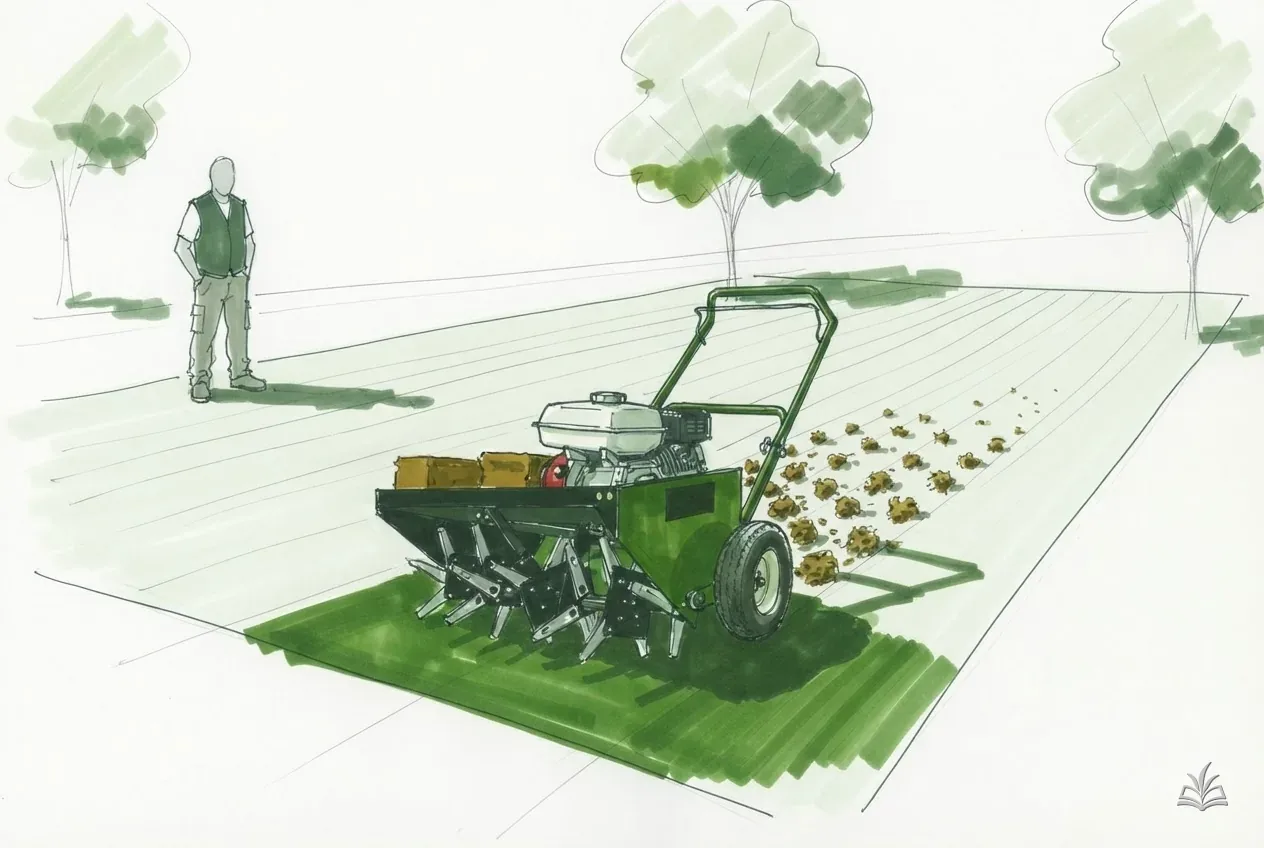
$15–$25 / 1,000 sq ftA machine pulls 2–3 inch soil plugs and drops them on the surface. The holes let air, water, and fertilizer reach the roots, and relief lasts a full season.
Best for: Clay soil, heavy foot traffic, lawns that puddle after rain
Verdict: The standard for compacted soil. Turfgrass extension guidance generally favors pulling cores over punching holes, and it's the version pros quote by default.
Spike aeration
$9–$15 / 1,000 sq ftSolid tines punch holes without removing soil. Faster and cheaper, but the tines compress the hole walls, so on clay it can make compaction slightly worse.
Best for: Sandy or loamy soil with mild compaction
Verdict: A light-duty refresh between core aerations — not a substitute on clay.
Liquid aeration
$8–$14 / 1,000 sq ftA surfactant solution loosens the soil surface so water penetrates deeper. No machine, no plugs, no marking sprinkler heads.
Best for: Lawns with irrigation heads and buried lines everywhere, or as a supplement
Verdict: Cheapest and easiest to add on, but it does not physically relieve compaction. Results build slowly over repeat applications.
DIY Rental vs. Hiring a Pro
DIY rental
$79–$113
4-hr / 24-hr block, Home Depot 2026 rates
- • A walk-behind core aerator covers roughly 10,000–15,000 sq ft per hour, so most lawns fit in a half-day block
- • Machines weigh 200–300 lbs — you need a truck or trailer and a second pair of hands to load
- • Split the rental with a neighbor and DIY drops under $50 per lawn
Hire a pro
$75–$206
Per visit, national range (Angi 2026)
- • On lawns under ~1/4 acre, hiring often costs about the same as renting once you count truck time and fuel
- • Pros mark sprinkler heads, make two passes, and bundle overseeding the same visit
- • Break-even math: DIY only wins clearly above ~10,000 sq ft or if you aerate every year
What Pros Charge (and How to Bundle It)
Core aeration quotes run $15–$25 per 1,000 sq ft with a per-visit minimum. Mid-market work clusters in the $15–$18 band (Today's Homeowner, 2026); small lots and slopes push toward the $25 end, where the trip minimum does most of the work. That spread plus the minimum is why the national per-visit average sits near $141 despite huge variation in lawn size. Use pro mode in the calculator above to build your quote from labor, machine, and overhead instead of guessing.
Price at 3–4x your mowing rate, floor at $75–$100
GreenPal's pricing guidance pegs aeration at 3–4 times the regular mowing rate for the same lawn — the machine is slower, heavier, and needs two passes on bad compaction. Whatever the math says, hold a trip minimum: a $45 aeration ticket loses money once you count loading, travel, and sprinkler-head flagging.
Bundle overseeding — it adds roughly 65–80% for 20 extra minutes
The aeration holes are the perfect seed bed, so aeration + overseeding sells itself in fall. Seed for 8,000 sq ft costs you roughly $40–$60 wholesale, and the bundle adds $80–$160 to the invoice. Quote all three tiers: aerate only, aerate + seed, aerate + seed + starter fertilizer.
Route density is where the margin comes from
A walk-behind unit covers 10,000–15,000 sq ft per hour, so the aerating itself is 30–60 minutes on a typical lawn — travel and setup eat the rest. Pros who blitz one neighborhood in a week (door hangers, postcard drop) can stack 8–10 jobs a day off a single rental. As an illustration, not a benchmark: 8 jobs at a $120 suburban ticket is $960 of revenue against roughly $113–$158 of machine cost for the day — the 24-hour rental rate, or two of the $79 four-hour blocks — before labor, fuel, and seed.
Timing the upsell matters as much as the price: pitch it when cool-season lawns hit their fall overseeding window, and put aeration on your printed rate card — our price sheet template has a slot for it. The lawn care pricing guide covers benchmarks for every other service on the truck.
When Aeration Is Worth Paying For
Timing decides whether the money works. Aerate cool-season lawns (fescue, bluegrass, rye) in early fall and warm-season lawns (bermuda, zoysia) in late spring — the full timing breakdown is in our lawn aeration guide. If your real problem is a spongy thatch layer over half an inch thick, budget for dethatching instead — see when to dethatch a lawn. And if you're overseeding into the aeration holes, size the bag first with the grass seed calculator — buying seed by guesswork is the most common way the “cheap” DIY route ends up costing more than the pro quote.