Lawn Size Calculator
Work out exactly how many square feet of grass you have. Add your lawn as simple shapes, subtract the house, driveway, patio, and beds, and get your total in sq ft, sq m, and acres — plus what that number means in seed, sod, fertilizer, and mowing prices.
Quick answer
The average U.S. yard is roughly a quarter acre (about 10,000 sq ft), based on HomeAdvisor's state-by-state lot analysis — but the actual grass area is smaller once you subtract the house and hardscape, typically 5,000–8,000 sq ft of turf on a ¼-acre lot. Nationally it adds up: NASA researchers estimated U.S. lawns cover about 40 million acres, making turf grass the country's largest irrigated crop. Measure yours precisely with the calculator below.
Pre-filled with a typical ¼-acre suburban lot: the full lot minus the house, driveway, patio, a tree ring, and a front bed. Remove those shapes and add your own.
Add a shape
Your shapes (6)
+10,800 − 2,836 sq ft
- +10,800 sq ft
Lot · Rectangle
120 × 90 ft
- −1,800 sq ft
House · Rectangle
50 × 36 ft
- −640 sq ft
Driveway · Rectangle
40 × 16 ft
- −192 sq ft
Patio · Rectangle
16 × 12 ft
- −79 sq ft
Tree ring · Circle
Ø 10 ft
- −125 sq ft
Front bed · Trapezoid
30 + 20 × h 5 ft
Total Lawn Area
7,964 sq ft
Square Feet
7,964
Square Meters
740
Acres
0.183
What 7,964 sq ft means for your lawn
Grass seed (new lawn): 24–64 lbs at 3–8 lbs per 1,000 sq ft depending on species — dial it in with the grass seed calculator.
Sod: ~18 pallets at 450 sq ft per pallet — price it with the sod calculator.
Fertilizer: ~2 bags per application (typical bag covers 5,000 sq ft) — get exact NPK amounts with the fertilizer calculator.
Mowing time: ~22 min push · ~7 min riding 42″ · ~5 min zero-turn 60″ — or see what pros charge with the mowing cost calculator.
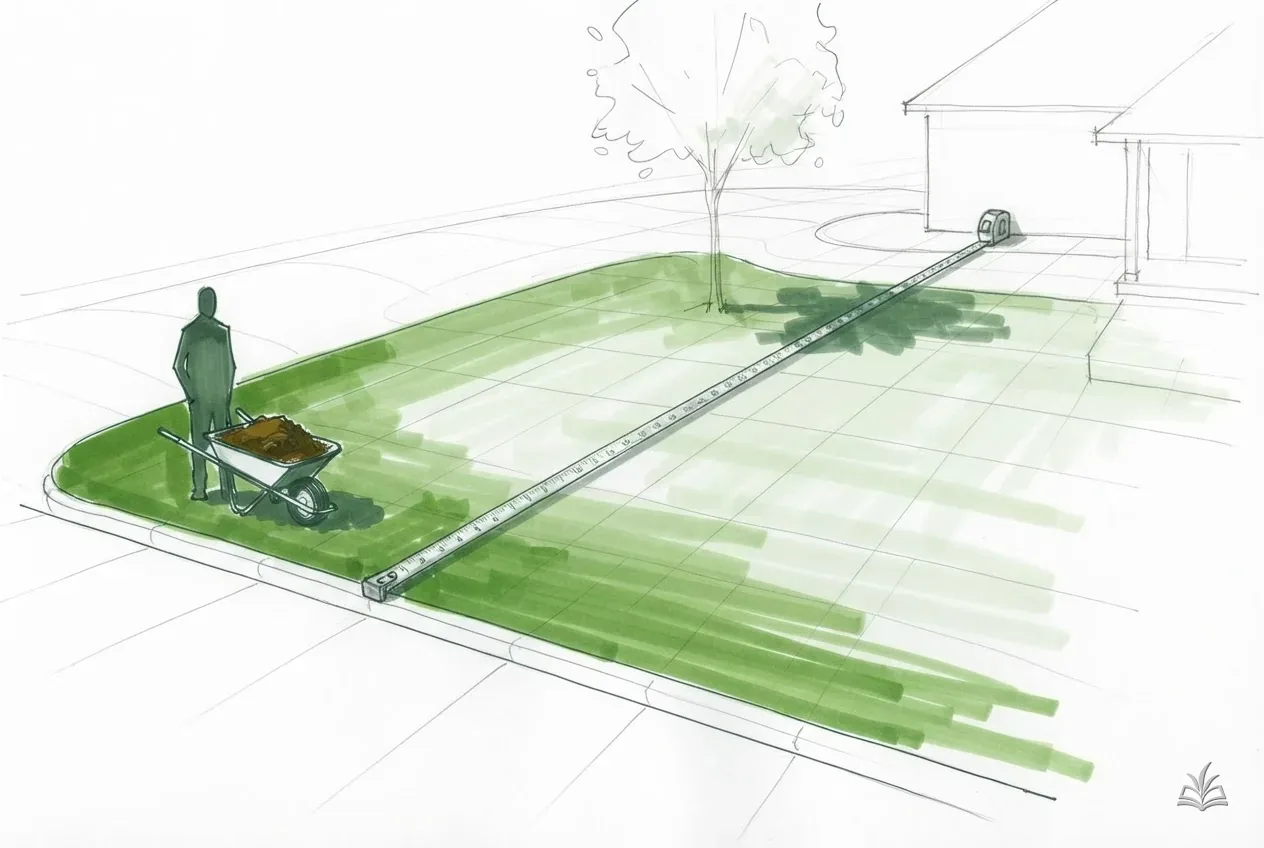
What Is a Lawn Size Calculator?
A lawn size calculator converts real-world measurements into your lawn's total square footage. Because almost no lawn is a clean rectangle, this one works like a pro's take-off sheet: you build the lawn from simple shapes (rectangles, circles, triangles, trapezoids) and subtract everything that isn't grass. That single number then drives every other decision — how much seed to buy, how many sod pallets to order, how many bags of fertilizer per application, and what a fair mowing price looks like.
How to Use This Calculator
- 1Sketch your property from above and break the lawn into simple shapes — rectangles for the main sections, triangles for corners, circles for rounded islands, trapezoids for tapered side yards.
- 2Measure each shape’s dimensions (pace it, roll a measuring wheel, or pull them from Google Maps — methods below) and add each one as a “Lawn area” shape.
- 3Switch to “Subtract” and remove everything that isn’t grass: house footprint, driveway, patio, shed, pool, and planting beds.
- 4Or start faster: enter your full lot from county records as one “add” rectangle, then subtract the non-grass areas.
- 5Read your total in square feet, square meters, and acres — plus what it means in seed, sod pallets, fertilizer bags, and mowing time.
- 6Copy or print the shape-by-shape breakdown for your records — it doubles as measurement documentation on a bid.
Tip: the beds you subtract here are exactly what you'd plug into the mulch calculator — measure once, use the numbers twice.
How to Measure Your Lawn: 4 Methods
Pick the method that matches the stakes. Pacing is fine for a fertilizer run; a sod pallet order deserves a measuring wheel.
Pacing (free, ±10% accuracy)
One relaxed adult stride is roughly 2.5–3 feet. Walk the length and width of each lawn section counting steps, multiply steps by your stride length, and you have workable dimensions in under five minutes. Calibrate first: walk a known 50 ft distance (a driveway you’ve measured) and divide by your step count. Good enough for fertilizer and seed — not for a sod order.
Measuring wheel or tape (±2%)
A $25–$40 measuring wheel is what lawn care pros actually use on estimates — roll it along each edge and read the dial. This is the standard when the number drives money: sod orders, hydroseeding quotes, or per-square-foot pricing on a bid.
Google Maps / Earth area tool (±5%)
In Google Maps, right-click your property and choose “Measure distance,” then click around your lawn’s perimeter to close the loop — the area in square feet appears at the bottom. Tree canopy is the main error source: satellite view hides the lawn edge under trees, so verify shaded sections on foot.
County GIS / property records (lot size only)
Nearly every U.S. county publishes a free GIS parcel viewer — search “[your county] GIS parcel map.” It gives exact lot dimensions and total lot area from the plat survey. Enter the lot as your “add” shape, then subtract the house footprint (also usually listed in tax records), driveway, and hardscape with this calculator.
Measuring for a bid? Pair your square footage with the mowing cost calculator and our guide to pricing lawn care jobs to turn the measurement into a quote.
Lawn Size Reference: Square Feet to Acres
One acre = 43,560 sq ft. Most product labels (seed, fertilizer, pre-emergent) are rated per 1,000 sq ft, so knowing your number in thousands is the practical unit.
| Sq Ft | Acres | What it looks like |
|---|---|---|
| 2,000 | 0.046 | Small urban front + back yard |
| 5,000 | 0.115 | Typical city-lot lawn (the industry’s default “standard lawn”) |
| 7,500 | 0.172 | Suburban lawn on a ¼-acre lot after the house and driveway |
| 10,890 | 0.25 | Quarter-acre — a common full suburban lot size |
| 21,780 | 0.5 | Half-acre — large suburban / edge-of-town lot |
| 43,560 | 1.0 | One acre — roughly a football field without the end zones |
| 87,120 | 2.0 | Small rural property — riding mower territory |
How Lawn Size Affects Pricing
Square footage is the first input in almost every lawn care price. Most pros price mowing from a base rate per 1,000 sq ft with a per-visit minimum ($30–$50) that covers drive time and loading — which is why a 2,000 sq ft lawn doesn't cost half of a 4,000 sq ft one. Per-square-foot rates then drop as size grows: once the crew is on site, each extra thousand square feet is cheap to add.
Rule of thumb: mowing runs roughly $6–$12 per 1,000 sq ft per visit, with the rate falling toward the low end above 10,000 sq ft.
Fertilization, aeration, and overseeding are also quoted per 1,000 sq ft — your measurement here feeds all of them.
For full per-service benchmarks, see the lawn care pricing guide. If you run a lawn care business, an accurate measurement protects your margin on every recurring visit — underestimate by 20% and you mow that 20% free all season. Our aeration cost calculator uses the same square footage you just measured.