How to Get Rid of Grubs in Your Lawn: Timing, Products & Repair
August 24, 2026 · Updated October 18, 2026 · 14 min read
5–10
grubs per sq ft = treat
Below 5 per square foot, healthy irrigated turf outgrows the feeding and treatment is wasted money (Michigan State and Purdue Extension). Above 10, expect visible damage by September. The exact line depends on which grub you dug up:
Most grub jobs go wrong for one reason: the product went down at the wrong time. A preventive applied in September does nothing. A curative applied in May hits grubs that are already too big to kill. This guide walks through how to confirm you actually have a grub problem, when each product works (by month, for cool-season northern lawns), what the organic options can and cannot do, how to repair the dead turf, and what pros charge. It pairs with our lawn fertilizer schedule and fall lawn care checklist, since grub control slots into the same calendar.
Signs You Have Grubs (and the 1-Square-Foot Dig Test)
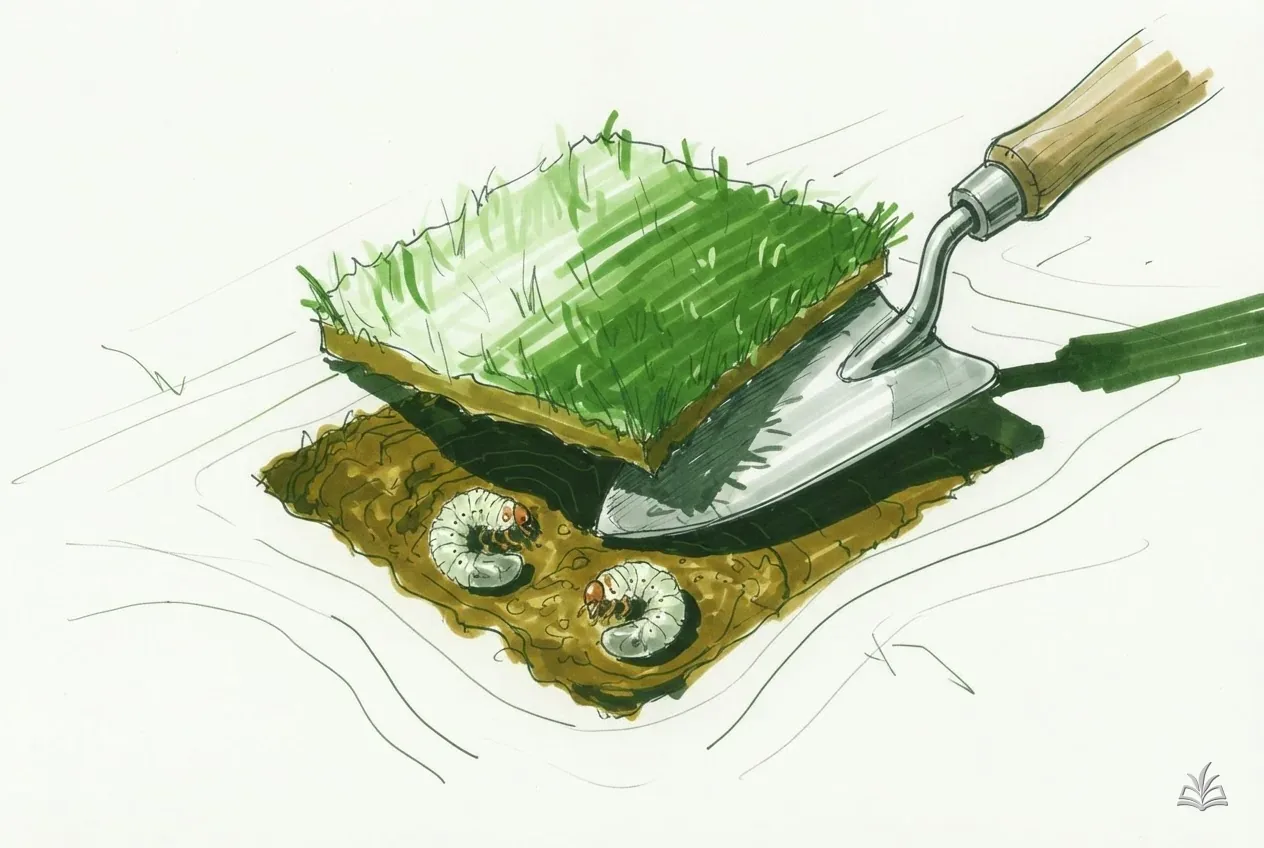
“Grubs” are the larvae of scarab beetles: Japanese beetle, European chafer, masked chafer, and a few regional cousins. They live 1–3 inches below the surface and chew through grass roots. Half of the “grub damage” calls a lawn company gets are actually drought, fungus, or dog urine, so confirm before you spend money on product.
Turf lifts like carpet
Grubs eat roots, so the sod loses its anchor. Grab a handful of brown grass and pull: if it peels back in a sheet with no resistance and no roots underneath, that is grub feeding, not drought.
Brown patches that ignore water
Irregular dead or wilting areas that show up late August to October and do not green up after watering. Drought stress recovers in a few days; root loss does not.
Skunks, raccoons, and moles tearing up turf
Animals dig for grubs at night and flip up divots of sod. Heavy digging often does more visible damage than the grubs themselves.
Flocks of birds working one area
Starlings and crows walking a lawn and probing the same patch for days are usually pulling grubs from just under the surface.
The dig test
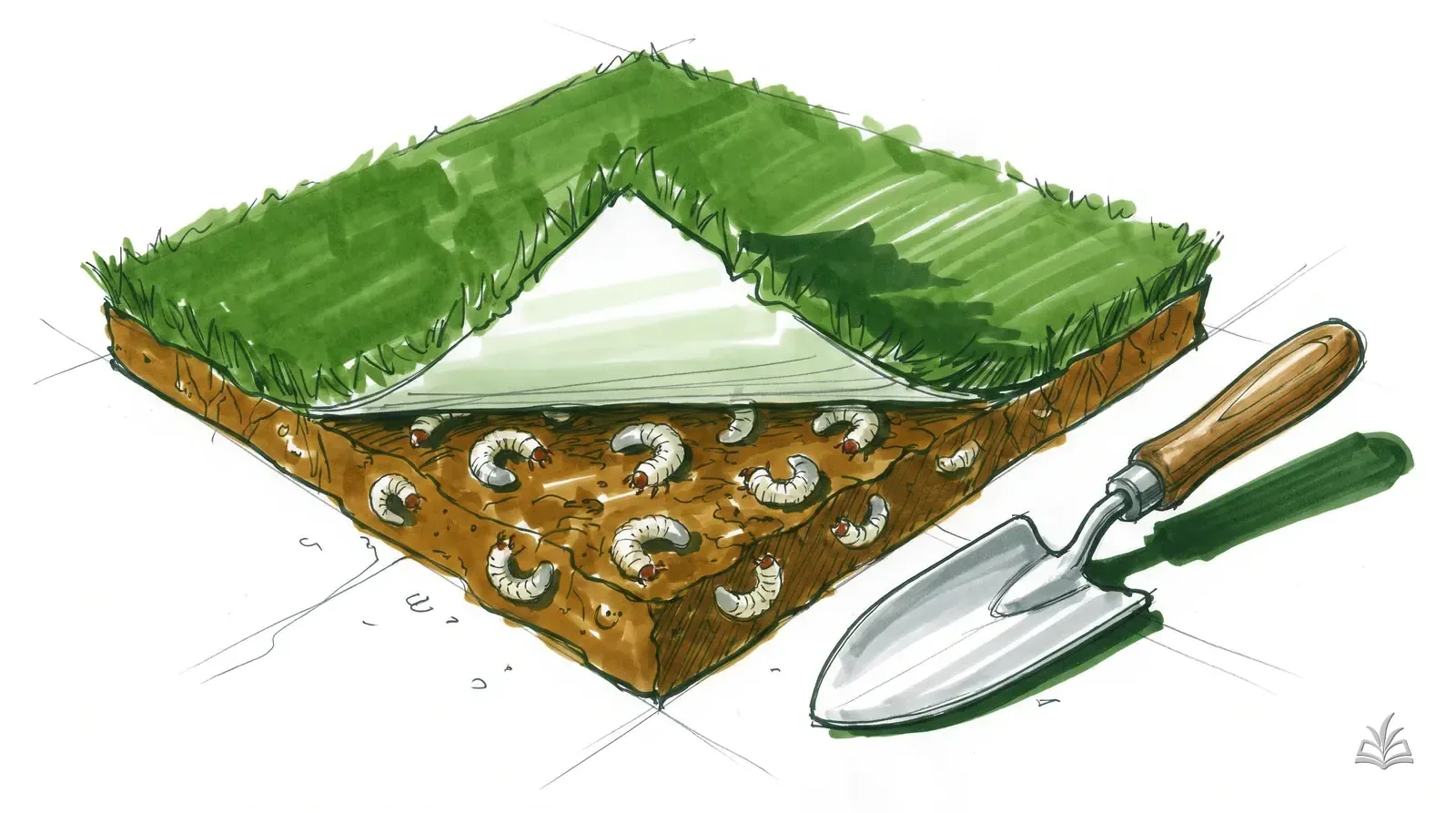
This is the only way to get a real count. It takes ten minutes and it is what separates a pro estimate from a guess. Purdue Extension samples with a cup cutter or spade to a 3-inch depth; a square-foot flap works just as well.
Pick 3–5 spots along the edge of the brown area (grubs are in the transition zone, not the dead center where they already ate everything).
Cut three sides of a 12 × 12 inch square with a spade, 3 inches deep, and fold the sod back like a flap.
Break apart the soil and count every C-shaped, cream-colored grub with a brown head. Note the size: under ½ inch means young larvae (August); ¾ to 1 inch means third instars (September or spring).
Average your counts. Under 5 per square foot: skip insecticide and fix the turf. 5–10: treat if the lawn is stressed or animals are digging. Over 10: treat.
Rule out the look-alikes first. Brown patches that stay rooted and appear in July heat are usually drought or a fungus. Patches with a high-nitrogen ring around a dead center are dog spots. If the soil is compacted and the grass is thin everywhere, the fix is core aeration and a soil pH test, not insecticide.
Grub Life Cycle Timeline by Species
Every product decision comes from this chart. Preventives have to be in the soil before eggs hatch (July). Curatives only work while larvae are small and near the surface (August to mid-September). By October the grubs are big, and by November they have moved down below the frost line where nothing reaches them.
- +Japanese beetle: Annual. Adults late June–Aug; hatch late July; heaviest feeding Aug–Oct.
- +European chafer: Annual, cold-tolerant. Feeds later into fall and earlier in spring than the others.
- +Masked chafer: Annual. Adults late June–early July; eggs hatch in 2–3 weeks; damage Aug–Oct.
“The damage you see in September was decided in June. Grub control is a calendar problem before it is a product problem.”
Southern and transition-zone lawns: shift everything 2–4 weeks earlier. Masked chafers dominate in the Plains and South; Japanese beetle is the main pest east of the Mississippi; European chafer is concentrated in the Northeast, Great Lakes, and Pacific Northwest. Timing above reflects Michigan State, Cornell, and Purdue Extension guidance for northern cool-season turf.
Preventive vs. Curative Grub Control Products
Two product families, two completely different windows. Preventives go down before hatch and stop the problem for the year. Curatives are the fire extinguisher: applied after you have confirmed grubs with the dig test. Windows below are for northern cool-season lawns and follow Michigan State, Purdue, Nebraska, and Iowa State Extension guidance. Always follow the label on the bag; it is the legal document, not this table.
| Active ingredient | Type | Apply | Notes |
|---|---|---|---|
Chlorantraniliprole Acelepryn, Scotts GrubEx | Preventive | Mid-Apr – mid-Jun | Lowest bee toxicity of the group; not a restricted-use product; most forgiving timing |
Imidacloprid Merit, BioAdvanced Season Long Grub Control | Preventive | Jun 1 – Jul 15 | Mow flowering clover/weeds before applying (pollinator risk); 75–100% control when watered in (MSU) |
Thiamethoxam / clothianidin Meridian, Arena | Preventive | Jun 1 – Jul 15 | Same pollinator caution; mostly pro-channel products |
Trichlorfon Dylox, BioAdvanced 24 Hour Grub Killer Plus | Curative | Aug – mid-Sep | Best rescue product; effectiveness drops fast as grubs grow; useless after early October (Iowa State) |
Carbaryl Sevin granules | Curative | Aug – mid-Sep | Highly toxic to bees and earthworms; MSU rates curatives at only 20–80% control |
Pollinators and pets: neonicotinoids (imidacloprid, thiamethoxam, clothianidin) and carbaryl are toxic to bees. Michigan State Extension's rule: mow so nothing is flowering in the lawn at application, then water in immediately. Keep pets and kids off treated turf until granules are watered in and the surface is dry. If you are applying for pay, see the licensing note in the pro section below and time this around your fertilizer schedule.
Organic & Biological Options: Nematodes vs. Milky Spore vs. Btg
Customers ask for “something natural” every year. Two of the three options are worth offering. One is not, and pros lose credibility when it fails.
| Option | Kills | When | Results |
|---|---|---|---|
Beneficial nematodes Heterorhabditis bacteriophora (Hb) | All common grub species | Aug – Sep (young larvae), soil 60–85°F | Fair to good |
Milky spore Paenibacillus popilliae | Japanese beetle grubs ONLY | Any time soil is above 60°F; 2–3 years to establish | Poor |
Bt galleriae (Btg) Bacillus thuringiensis subsp. galleriae; retail availability is spotty | Japanese beetle, masked chafer, European chafer | Jul – Aug (early instars) as preventive/early curative | Moderate (70–80% in university trials) |
Beneficial nematodes
Live product: buy fresh, refrigerate, apply at dusk or on a cloudy day, water in immediately and keep soil moist for 7–10 days. Hb actively hunts and moves deeper than Steinernema species, which is why it is the one to buy for grubs (Maryland Extension).
Milky spore
Does nothing to chafers, which are the main pest in much of the North. Extension trials in colder climates found it fails to build up in the soil and gives little measurable reduction. Do not sell this as grub control.
Bt galleriae (Btg)
A bacterial toxin the grub has to eat, so it works best on small larvae. Safe for bees and pets. Costs more per 1,000 sq ft than synthetic preventives.
The cultural fix that beats all of them: beetles lay eggs in moist, short, sunny turf in July. Mowing at 3–3.5 inches and watering deep but infrequently (or letting the lawn go dormant in July) makes the lawn less attractive for egg-laying and makes the turf strong enough to shrug off 5–8 grubs per square foot. Michigan State Extension calls this the single most effective non-chemical tactic.
Watering In & Repairing Grub-Damaged Turf
Watering in is not optional
Every grub insecticide, synthetic or biological, has to get through the thatch and into the root zone where the larvae are. Granules sitting on dry thatch do nothing and can break down in sunlight within days.
0.5–1 in
Preventives
immediately after (MSU)
0.5 in
Curatives
same day; more if thatch is thick (Iowa State)
0.25 in before + after
Nematodes
keep moist 7–10 days
Pro workflow: apply the morning before forecast rain, or leave the customer a written note that the sprinklers must run 30 minutes per zone that day. If they have no irrigation, schedule the application and run a hose-end sprinkler yourself. Put “watered in” on the invoice line. If the sprinkler system is already blown out for winter, you are too late for curatives anyway (see the sprinkler winterization guide).
Repairing the damage: 5 steps
Killing the grubs does not bring the grass back. Roots are gone, and those patches will be weeds by next June unless you reseed them. The good news: grub damage peaks in September, which is also the ideal cool-season seeding window.
Rake out the dead turf
Dead sod lifts off in sheets. Pull it up, plus any loose thatch, so seed can reach soil. Bag it; do not compost live grubs.
Tamp or roll loose soil
Animal digging leaves the surface fluffy. Foot-tamp or roll it back down so the seedbed is firm and level with the surrounding lawn.
Loosen the top ½ inch and seed
Scratch the surface with a rake, then seed at the bare-soil rate for your grass type (roughly 2× the overseeding rate). Size the order with the seed calculator so you buy the right bag. See the grass seed calculator.
Starter fertilizer, then water light and often
A starter blend with phosphorus (e.g. 10-18-10) and 2–3 light waterings a day for the first 10 days. Follow the full watering phases in the overseeding guide. See the overseeding guide.
Sod if the customer needs it green this week
For high-visibility patches or a lawn that is more than 50% gone, sod is faster and prevents weeds from filling the void first. See the sod installation guide.
Takeaway: a curative application and a repair seeding are two separate line items. Sell them together in September, and book the preventive for next May before you leave the driveway. If the whole lawn is thin, pair the repair with core aeration and a full overseed.
What Pros Charge for Grub Treatment (and Licensing)
Grub control is one of the better-margin add-ons in lawn care because the product is cheap relative to the ticket and it stacks onto a visit you are already making. Published 2026 ranges from Angi and LawnStarter:
| Service | Range | Source / note |
|---|---|---|
| Preventive application (per visit) | $30 – $80 | Angi; typical 5,000 sq ft lawn, product + labor |
| Curative treatment, active infestation | $200 – $600 | Angi; includes inspection, product, watering in |
| DIY chlorantraniliprole (GrubEx-type bag) | $20 – $40 | Retail bag covering 5,000 sq ft |
| Core aeration (repair add-on) | $107 – $202 | LawnStarter |
| Dethatching (repair add-on) | $65 – $165 | LawnStarter |
A workable pricing model for a solo operator: product cost per 1,000 sq ft (about $4–$5 for chlorantraniliprole, half that for imidacloprid) plus a flat $45–$60 stop fee, with a $75 minimum. Curatives justify a higher ticket because they require a site inspection and a dig test. Bundle the spring preventive into an annual program alongside fertilizing; that is how the national brands price it. For the full per-service math see the lawn care pricing guide and how to price lawn care jobs.
Licensing note: in every U.S. state, applying any pesticide (including grub insecticides and, in most states, biological products sold as pesticides) on someone else's property for compensation requires a commercial pesticide applicator license or working under a licensed applicator. Some products, including several neonicotinoid formulations, are pro-channel or state-restricted with extra requirements. Mowing companies get fined for this every season. Details and how to get certified are in the landscaping business license guide; make sure your liability insurance actually covers chemical application before you sell it.
7 Grub Control Mistakes That Waste the Application
Each of these turns a $40 bag of product into a callback.
Treating in spring for grubs you found in spring
Wrong: Seeing big grubs while edging beds in April and putting down a curative.
Right: Spring grubs are third instars days from pupating; curatives barely touch them and the damage is already done. Repair the turf and apply a preventive in May–June for the next generation.
Applying a preventive in the fall
Wrong: Spreading GrubEx or imidacloprid in September because the lawn looks bad.
Right: Preventives target newly hatched larvae. By September the larvae are large and the preventive is wasted. Use a curative now, preventive next spring.
Not watering it in
Wrong: Dropping granules on dry turf in a drought and leaving.
Right: Half an inch of water immediately. Michigan State found no reliable control from preventives that were not watered in.
Skipping the dig test
Wrong: Selling a curative for every brown patch.
Right: Ten minutes with a spade. Under 5 grubs per square foot is not a grub job. Customers remember when the second treatment also did nothing.
Recommending milky spore for chafers
Wrong: “It’s natural and it lasts 10 years.”
Right: Milky spore only affects Japanese beetle larvae and performs poorly in northern soils. For an organic option, sell Hb nematodes or Btg instead.
Spraying neonics over blooming clover
Wrong: Imidacloprid over a lawn full of white clover in June.
Right: Mow first so nothing is flowering, then apply and water in. Bee kills are a label violation and, for licensed applicators, a reportable one.
Treating the whole lawn when the sun side is the problem
Wrong: Full-lawn curative at full price.
Right: Beetles lay eggs in sunny, moist, short turf. Sample the shady side too; often only 30–50% of the lawn is over threshold and the customer gets a cheaper, targeted treatment.
Quick Reference Card
Screenshot this for the truck. Northern cool-season timing; shift 2–4 weeks earlier in the South.
Grub Control — Cheat Sheet